











Summary


Walk into any urgent care center on a Monday evening during flu season, and you’ll see medical assistants moving between exam rooms, the front desk, and the phone almost without a pause.
Now, if you are interested in an urgent care medical assistant role, you need to understand the daily duties before you accept a job offer (it is important to make a decision) because this setting runs on a different rhythm than a scheduled physician’s office.
This is what you need to know about the real job description, what the pace feels like hour to hour, and the skills that actually get candidates hired.
Key Takeaways
|
What Is an Urgent Care Medical Assistant?
An urgent care medical assistant supports physicians, nurse practitioners, and nurses in a walk-in clinic built to treat illnesses and injuries that need same-day attention but don’t require an emergency room.
Instead of working from an appointment book, you handle whoever arrives that hour, and it can be anyone from someone with a sprained ankle and a strep test to a serious work injury to a choking child.
With that said, even this role blends the same clinical and administrative foundation found in any medical office, applied to a faster-moving patient mix.
How It Differs From a Traditional Medical Assistant Role
In a private practice, a medical assistant often works with the same patients over months or years, following a schedule built around booked appointments. An urgent care medical assistant rarely treats the same patient twice, and the day’s structure depends entirely on who walks through the door. According to Experity Health, the medical assistant’s core function in this setting is to manage patient flow so physicians can stay focused on treatment rather than logistics.
What Are the Pros and Cons of Urgent Care vs. Traditional Medical Assistant Roles?
| Factor | Urgent Care | Traditional Office |
| Patient volume | High and unpredictable, walk-in driven | Steady, appointment-based |
| Schedule | Often includes evenings, weekends, and holidays | Usually standard business hours |
| Task variety | Wide mix of acute conditions daily | Narrower, often specialty-focused |
| Predictability | Low — no two days look alike | High — routines repeat |
| Skill-building speed | Fast exposure to diverse clinical scenarios | Slower, deeper focus in one area |
| Pay | Often at or above median, sometimes with shift differentials | Typically standard base pay |
So, is urgent care better than a traditional office setting? Neither setting is inherently better; it comes down to what energizes you.
- If a predictable routine and long-term patient relationships appeal to you, a private practice or specialty office may fit better.
- If variety, quick problem-solving, and exposure to a wide range of conditions sound appealing, urgent care tends to be the better match.
Medical Assistant Urgent Care Duties: The Full Job Description
Job postings for this role typically list a mix of clinical and administrative responsibilities, and most urgent care medical assistants handle both in the same shift.
Clinical Duties in a Typical Shift
Clinical responsibilities usually include:
- Taking and recording vital signs and documenting the chief complaint before the provider walks in
- Performing point-of-care tests such as strep, flu, COVID-19, and mono swabs
- Assisting with wound care, including cleaning, dressing, and suture or staple removal
- Applying splints and orthopedic dressings for minor fractures and sprains
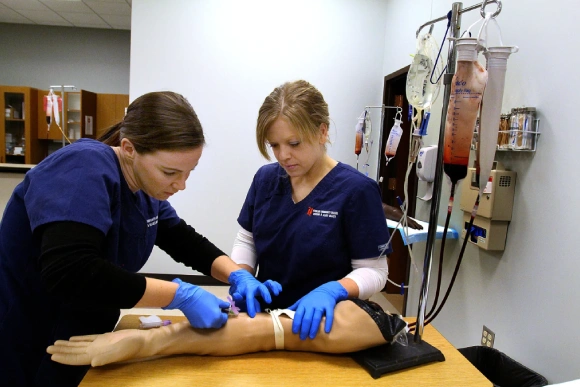
- Drawing blood and collecting specimens for lab work
- Preparing patients for X-rays or performing basic EKGs, depending on state scope-of-practice rules
- Administering medications or injections where state regulations and facility policy allow
NOTE: Scope of practice varies by state, i.e., some restrict medical assistants from giving injections or performing certain procedures, so always confirm what’s allowed locally.
Administrative & Front-Office Duties
Administrative duties round out the job description:
- Checking patients in and verifying insurance or collecting copays
- Answering phones and scheduling follow-up visits or referrals
- Updating the electronic medical record with vitals, history, and provider notes
- Coordinating lab and imaging orders with outside facilities
- Restocking exam rooms and tracking medical supply inventory
- Preparing discharge paperwork and explaining at-home care instructions
For more detail on how these responsibilities compare across settings, see this breakdown of clinical medical assistant duties.
The Pace of an Urgent Care Medical Assistant Job

Patient Volume and Walk-In Flow
Because urgent care runs on walk-ins rather than a booked schedule, patient volume can swing sharply within a single shift. A quiet Tuesday morning can turn into a packed waiting room by early evening, especially during flu season or after a local sports event. You won’t always know how many patients are coming, only that you need to be ready for whatever shows up.
Multitasking Under Time Pressure
A single hour might require you to room a patient, run a rapid strep test, answer the phone, and update a chart — often in that order, sometimes out of order. Employers expect medical assistants to prioritize the most urgent task and handle it without letting quality slip. That’s a skill that develops with repetition, not something most people arrive with on day one.
Is Urgent Care More Stressful Than a Primary Care Office?
It can be, but “stressful” isn’t always the right word. As mentioned above, it can be “unpredictable”. Primary care offices run on a schedule you can see coming; urgent care runs on whoever walks in next. Medical assistants who thrive in urgent care tend to enjoy that unpredictability rather than feeling drained by it, and strong time-management habits make the pace far more manageable than it looks from the outside.
Example of a Day in the Life of an Urgent Care Medical Assistant
Note: The following schedule is a sample representation. Due to the fast-paced and walk-in nature of urgent care, daily timelines, patient volumes, and duties vary significantly from shift to shift.
- 7:45 AM – Clinic Opening & Prep: Arrive early to unlock exam rooms, sanitize equipment, turn on diagnostic devices, and review the initial walk-in queue and daily supply levels.
- 8:30 AM – Morning Rush: Triage early walk-ins by taking vitals, taking down chief complaints, and performing rapid point-of-care tests (e.g., strep, flu, COVID-19) to keep patient flow moving smoothly.
- 11:00 AM – Clinical Procedures & Coverage: Assist the attending provider with minor procedures, such as cleaning and dressing wounds, applying splints, or running EKGs, while covering front-desk check-ins during lunch rotations.
- 2:00 PM – Lab Work & Administrative Tasks: Process and log lab specimens, update Electronic Health Records (EHR), make follow-up phone calls, and coordinate referrals or imaging orders.
- 5:00 PM – Evening Peak & Room Turnovers: Manage the end-of-day influx of after-school and post-work patients, ensuring rooms are sanitized and re-stocked between treatments.
- 7:30 PM – Wrap-Up & Hand-off: Complete final EMR charts, secure lab samples for pickup, restock medical supplies for the next morning, and lock down the facility.
Skills Employers Look for in Urgent Care Medical Assistants
Clinical & Technical Skills
Employers consistently screen for a core set of clinical competencies: taking accurate vital signs, basic phlebotomy, EHR documentation, and comfort operating point-of-care testing equipment. Familiarity with medical terminology also speeds up communication with providers during a busy shift.
These skills are something that can only be developed with practice, which is the reason why CCI Training Center’s Medical Assistant Training Program includes a practice kit and a dedicated externship module. |
Soft Skills That Matter Most in Fast-Paced Settings
Clinical know-how only goes so far without the soft skills to match. The traits that show up again and again in employer expectations include:
- Clear communication with patients, families, and the care team
- Comfort multitasking without letting details slip
- Composure when the waiting room fills up faster than expected
- Adaptability, since no two shifts look exactly alike
For a deeper look at which soft skills matter most and how to build them, check out this guide to medical assistant soft skills.
Should You Join Urgent Cares as a MA Right Now OR Later?
Short answer: Right now. The industry statistics show that joining an urgent care as an MA right now is beneficial.
Industry Growth and Staffing Demand
The number of urgent care centers in the U.S. nearly doubled between 2014 and 2023, and the market is projected to keep expanding at close to a 10% annual growth rate through 2033, according to Grand View Research. That growth translates directly into hiring demand for support staff. At the same time, roughly a third of urgent care operators report ongoing staffing shortages, per Streamline Sci, which keeps openings for medical assistants steady across most metro areas.
Best Industries for Urgent Care Medical Assistants
Nationally, offices of physicians employ the largest share of medical assistants at 57%, according to the Bureau of Labor Statistics. Hospitals account for another 17%, and outpatient care centers — the category that includes most urgent care facilities — make up 10%. That outpatient segment has grown faster than physician offices in recent years, which lines up with the broader expansion of urgent care as a category.
How Much Do Urgent Care Medical Assistants Make?
Pay varies by state, certification, and employer, but the numbers below give a useful baseline.
| Data Point | Annual | Hourly |
| National median (all medical assistants) | $44,200 | ~$21 |
| Top 10% nationally | $56,480+ | ~$27+ |
The Bureau of Labor Statistics also projects 12% employment growth for medical assistants between 2024 and 2034, with roughly 112,300 openings a year — well above the average across all occupations.
For a full breakdown of what affects pay, see this medical assistant salary guide.
How to Become an Urgent Care Medical Assistant
Becoming an urgent care MA is more or less the same pathway as becoming a traditional MA.
What Certification Do You Need?
Most urgent care employers prefer or require certification, such as the Certified Clinical Medical Assistant (CCMA) credential through the National Healthcareer Association. Certification confirms you’ve mastered both the clinical and administrative sides of the role before day one, which matters in a setting that doesn’t leave much room for on-the-job ramp-up. A fast-track program with synchronous, teacher-led instruction and a hands-on externship gives you a head start on both.
Where Urgent Care Experience Can Take Your Career
Urgent care experience builds a broad clinical foundation quickly, which can make later moves into specialty practices, hospital settings, or nursing prerequisites easier down the road. Many medical assistants use a year or two in urgent care to figure out which specialty interests them most, then move into that setting once they’ve built confidence. For a full walkthrough of the training path, see this guide on how to become a medical assistant.
Final Words
Urgent care medical assistant duties cover a wide mix of clinical and administrative work, delivered at a pace that rewards multitasking and composure. The role pays competitively, and steady industry growth is keeping demand for qualified medical assistants high in most markets. If the fast pace and variety sound like the right fit, an urgent care MA role is for you.
 Pamela Christianson
 Pamela Christianson
 Pamela Christianson
 Pamela Christianson
 Pamela Christianson
 Pamela Christianson