














Summary
Medical Assistant vs. Radiology Technician: Career Comparison

If you’re comparing medical assistant vs. radiology technician (limited scope), you are looking for an allied healthcare role that is quick to start and offers job security. Luckily, both of these roles put you in a clinic or hospital within a year or two, both come with real earning potential, and both stay in steady demand.
With that said, the day-to-day work, the pay ceiling, and the training path are different enough that choosing either role takes some consideration.
This guide breaks down the difference between the medical assistant and radiology technician roles, compares salary, training, difficulty, and even how AI is likely to affect each career over the next decade.
Still, the short answer is: if you want variety — a mix of clinical and administrative tasks, faster entry, and the widest range of job openings — medical assisting fits better. If you want a narrower, more technical role built around diagnostic imaging with a higher long-term pay ceiling, limited-scope radiology technician is the stronger fit.
Key Takeaways
|
Medical Assistant vs Radiology Technician: Differences
The biggest difference between these roles is what they do on a daily basis. As daily duties can dictate your stress level, patient interaction, and long-term career direction.
What Does A Medical Assistant Do?
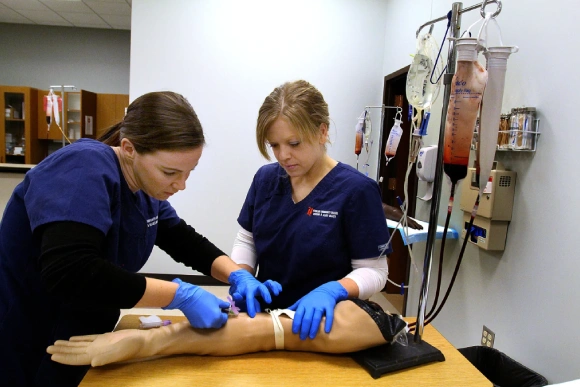
A medical assistant (MA) splits the day between clinical support and front-office work.
On the clinical side a MA might:
- Prepare patients for exams
- Taking vital signs
- Administer injections
- Perform basic lab work like phlebotomy
On the administrative side:
- Schedules appointments
- Updates electronic health records (EHR)
- Verifies insurance
- Manages the flow of a busy office
| Want to know more about the MA role in detail? Check our guide on what a clinical medical assistant does. |
Where Do Medical Assistants Work?
Most MAs work in physicians’ offices, though outpatient clinics, urgent care centers, and specialty practices hire heavily too. The role rewards people who like variety and don’t mind switching between hands-on patient care and desk work within the same hour.
Explore common places where MAs work.
What Does A Radiology Technician (Limited-Scope) Do?
A limited-scope rad tech takes basic X-rays of specific body areas, typically hands, feet, chest, knees, and extremities, under a physician’s or radiologist’s supervision.
Where Does a Rad Tech Work?
A limited-scope tech’s work stays centered on radiographic positioning, radiation safety, and image quality for a defined set of exams, and most work in physicians’ offices, urgent care centers, and outpatient imaging settings rather than hospital radiology departments.
Side-by-Side Comparison: Medical Assistant vs Radiology Technician
| Factor | Medical Assistant | Radiology Technician (Limited Scope) |
| Core focus | Clinical + administrative support | Diagnostic X-ray imaging of specific body areas |
| Typical setting | Physician’s offices, urgent care, clinics | Physician’s offices, outpatient imaging, urgent care |
| Training length | About 9–12 months | About 12–24 months |
| Credential | CMA, RMA, or CCMA (industry standard, not state-mandated) | LMRT license (State Medical Board, exam required) |
| Median pay | Around $44,200/year | Around $46,000/year (limited scope specifically) |
| Projected growth (2024–2034) | 12% | Not separately tracked by BLS; tied to outpatient imaging demand |
| Daily variety | High — clinical and front-office tasks | Lower — focused, repeatable imaging procedures |
Who Gets Paid More, Medical Assistant Or Radiology Technician?
Here’s an important distinction you need to keep in mind when comparing salary data. You may have noticed that a lot of comparisons between these two roles mention the Radiology Technician salary as approximately $77,000. Now, the issue with that statistic is that this wage is for a full-scope Radiology Technologist (RT). LSRTs earn less compared to an RT.
Limited-scope radiology technicians, who complete a shorter LMRT program and work exclusively with X-rays of specific body areas, earn closer to $31,000–$60,000 a year, with a median somewhere in the low-to-mid $40,000s depending on location and employer.
That puts limited-scope pay much closer to a medical assistant’s median of $44,200 than the eye-catching full-RT figure suggests. For a deeper breakdown, see this medical assistant salary guide.
So if the question is truly “medical assistant or radiology technician, which pays more” for the limited-scope path specifically, the honest answer is: it’s close, and it often comes down to your state, your employer, and whether you eventually add imaging credentials. The bigger pay jump associated with radiology only shows up once you pursue the full radiologic technologist track.
Job Outlook: Which Career Has Better Growth?
Medical assisting has a clear edge in overall job market size. The Bureau of Labor Statistics projects 12% growth for medical assistants between 2024 and 2034, with about 112,300 openings projected each year, driven by an aging population and the steady expansion of outpatient care.
Limited-scope radiology technician roles aren’t tracked separately by the BLS, since the agency groups all radiologic technologists and technicians together. That combined category is projected to grow more modestly, and most of that growth concentrates in hospital-based, full-scope imaging roles rather than limited-scope positions in outpatient settings. For more detail on where the growth is concentrated, this radiology technician job outlook breakdown covers it further.
Practically, that means medical assisting gives you more places to land a job without relocating, while limited-scope radiology technician openings stay more concentrated in specific settings like physicians’ offices and outpatient imaging centers.
Skills Required: Medical Assistant vs Radiology Technician
A medical assistant needs to multitask constantly, switching from taking a patient’s blood pressure to updating a chart to answering the phone, sometimes within minutes. Strong communication, attention to detail, basic clinical skills like phlebotomy and injections, and comfort with electronic health records all matter here.
A limited-scope radiology technician needs a different kind of precision. Understanding anatomy well enough to position a patient correctly, following radiation safety protocols exactly, and judging whether an image is diagnostically usable are the core technical skills. Patient communication still matters, since you’re explaining a procedure and keeping someone still and calm, but the daily rhythm is far more repeatable and procedure-driven than an MA’s.
Training and Certification: Medical Assistant or Radiology Tech?
Both paths at CCI Training Center run through synchronous, teacher-led online classes, so you’re getting real instruction rather than a self-paced video library. From there, the two programs diverge in length and what they lead to.
Medical assistant training is typically the faster path into the workforce. A structured, accelerated program can take you from enrollment to eligible-for-certification in roughly 9 to 12 months, covering clinical procedures, medical terminology, and administrative systems. From there, the CMA, RMA, and CCMA are the most recognized, trusted certifications employers look for.
| If this path fits what you’re looking for, you can explore the CCI Training Center’s medical assistant program to see how the training is structured. |
Limited-scope radiology technician training runs longer, typically 8 to 14 months, and ends in a state licensing exam rather than an optional industry certification. You also need to earn a credential from the American Registry of Radiologic Technologists on behalf of your state’s Medical Board to earn your LMRT license.
| If the more technical, imaging-focused path appeals to you, you can explore the CCI Training Center’s radiology tech training to see what that fast-track program covers. |
Which is More Difficult?
Neither role is objectively harder — the difficulty just shows up in different places.
Medical assisting is demanding because of its breadth: you’re expected to be competent at clinical tasks and administrative systems at the same time, and the pace rarely slows down.
Limited-scope radiology technician training leans more technical, with coursework in radiation physics, anatomy for imaging, and safety protocols that some students find more academically challenging than MA coursework.
Will AI Replace Radiology Technicians or Medical Assistants?
Neither role is at serious risk of full replacement, but AI is already changing pieces of both. For medical assistants, AI is taking over rule-based administrative tasks like appointment scheduling, basic billing, and some documentation, with McKinsey estimating that 36% to 43% of healthcare administrative tasks could be automated. The clinical side of the job, like taking vitals, administering injections, and direct patient interaction, stays firmly human, which is why overall automation risk for the role is considered low.
| For a broader look at which healthcare roles hold up best against automation, see this rundown of jobs safe from AI. |
For limited-scope radiology technicians, the pattern is similar but inverted. AI is making real inroads into image interpretation, a task distinct from patient positioning during image acquisition, where AI functions more as an assist than a replacement — but interpretation is the radiologist’s job, not the technician’s. The technician’s actual work, physically positioning a patient, adjusting equipment, and applying radiation safety protocols, remains an embodied, hands-on task that current AI tools don’t perform, and AI is more likely to support technologists by flagging positioning errors than to replace them outright.
How to Decide Which Role is Right for You in 5 Questions
- Do you want daily variety, or a focused technical specialty? Medical assisting mixes clinical and administrative work constantly; limited-scope radiology technician work is centered on one repeatable procedure.
- How do you feel about a state licensing exam versus an industry certification? For example, LMRT licensure in Texas is mandatory and exam-based; MA certification (CMA, RMA, CCMA) is the industry standard but not state-required.
- Would you rather start working sooner, or invest a bit more training time upfront? MA programs typically run shorter than LMRT programs.
- Are you drawn to physics- and anatomy-heavy coursework, or hands-on clinical multitasking? Each path leans into a different kind of difficulty.
- Where do you want to work day to day? Physician’s offices and urgent care lean MA-heavy; outpatient imaging centers lean toward limited-scope radiology roles.
Final Words
There’s no universally “better” choice between these two careers, only a better fit for how you want to spend your workday. Medical assisting gets you into the workforce faster, offers more job openings nationwide, and rewards people who like variety. The limited-scope radiology technician path takes a bit longer, narrows your daily work to diagnostic imaging, and can edge out medical assisting on pay once advanced imaging credentials enter the picture down the road.
Whichever direction fits you, our admissions officers and career support services are here to help you figure it out.
Program Offered
- Pharmacy Technician Training
- Online Medical Assistant
- Medical Billing and Coding Specialist Program
- Cloud Computing Technician Training
- Computer Network Technician
- Business and Accounting
- Radiology Technician Training
- Medical Assistant Program
- Computer Support Technician
- Cybersecurity Program
- Virtual Assistant Training

This article is written by
Share this article
Program Offered
- Pharmacy Technician Training
- Online Medical Assistant
- Medical Billing and Coding Specialist Program
- Cloud Computing Technician Training
- Computer Network Technician
- Business and Accounting
- Radiology Technician Training
- Medical Assistant Program
- Computer Support Technician
- Cybersecurity Program
- Virtual Assistant Training
This article is written by
Share this article
Frequently Asked Questions
What pays more, radiology or medical assistant?
It depends which radiology role is being compared. A full radiologic technologist out-earns a medical assistant significantly, but a limited-scope radiology technician’s pay sits much closer to a medical assistant’s median, often within a few thousand dollars depending on location and employer.
Is it harder to become a medical assistant or a radiology technician?
Medical assisting demands breadth across clinical and administrative skills, while limited-scope radiology technician training leans more academically technical, with anatomy and radiation safety coursework plus a mandatory state licensing exam. Neither is harder across the board; the difficulty depends on which type of learning suits you better.
Can a medical assistant become a radiology technician?
Yes, but it typically means enrolling in a separate limited-scope radiology technician program rather than simply adding a credential. Some medical assisting coursework, like anatomy and patient care fundamentals, can make the transition somewhat smoother, though a direct bridge program isn’t standard.
How long does it take to become a limited-scope radiology technician vs. a medical assistant?
Medical assistant programs typically take about 9 to 12 months to complete. Limited-scope radiology technician programs usually run closer to 12 to 24 months, partly because they end in a mandatory state licensing exam.
Do limited-scope radiology technicians make as much as full radiologic technologists?
No. Full radiologic technologists, who are credentialed for CT, MRI, and mammography in addition to X-ray, earn considerably more than limited-scope technicians, whose scope of practice is restricted to basic X-rays of specific body areas.
Related Articles
 Pamela Christianson
 Pamela Christianson
 Pamela Christianson
 Pamela Christianson
 Pamela Christianson

CCI Training Center Proudly Completes
41 Years in Career Training Services