













Key Takeaways
|
Many aspirants are inspired to pursue a career in medical assisting after seeing the salary ($44,200/year) and the job growth rate (12%). However, before choosing this path, it’s important to look beyond the numbers and understand what the role actually involves.
A career that seems attractive on paper may still raise practical questions, such as
- “Can I handle the pace of a busy workspace?” “
- Are the working hours manageable?”
- What does a typical day look like?”
Understanding these concerns is an important step before deciding whether this career is the right direction for you. Because the job might seem straightforward from the outside. But in reality, the role involves balancing several responsibilities throughout the day.
Read this guide, as we will give a realistic look at what a typical day in the life of a medical assistant really looks like. This information will help you decide whether this career aligns with your expectations and strengths.
Breaking Down a Medical Assistant’s Workday into Three Time Blocks
Before taking the next step in learning how to become a medical assistant, take a pause and get a clearer picture of the tasks you may handle as a medical assistant. We have broken down a typical workday into three time blocks: morning, afternoon, and evening. Let’s explore what responsibilities usually fall into each part of the day.
1. Morning
The morning hours are often the busiest time in any healthcare workplace as patients begin arriving for scheduled appointments. Therefore, medical assistants must prepare the workspace and support both clinical care and front-office operations.
a) Typical Morning Responsibilities
Medical assistants start their day by ensuring the workspace is ready to operate smoothly. This often includes:
- Reviewing the day’s appointment schedule
- Preparing and organizing examination rooms
- Checking that medical supplies and equipment are available
- Logging into electronic health record (EHR) systems
- Organizing patient charts and files
- Verifying insurance or patient registration details
b) Patient Intake Tasks
Once patients arrive, medical assistants shift their focus to patient intake and basic front-office coordination by performing several tasks listed below before the physician sees the patient:
- Greeting patients and confirming their personal information
- Recording vital signs, such as:
- Blood pressure
- Temperature
- Pulse rate
- Weight and height
- Asking about current symptoms or medical concerns
- Updating patient medical histories
By managing these responsibilities, medical assistants help physicians receive accurate patient information before examinations begin, allowing appointments to proceed more efficiently.
Morning Duties at a Glance
To help you better understand the purpose of each task, here is a quick table overview.

| Task | Purpose |
| Prepare exam rooms | Ensures equipment and supplies are ready |
| Review appointment schedule | Helps organize patient flow |
| Record vital signs | Provides doctors with essential patient data |
| Update patient charts | Keeps medical records accurate |
| Guide patients to exam rooms | Maintains smooth clinic operations |
2. Afternoon
By the afternoon, patient visits continue, but medical assistants often shift between clinical assistance and administrative responsibilities.
a) Patient Care Support
Medical assistants may assist physicians in several ways during appointments:
- Preparing patients for examinations or procedures
- Handing instruments to physicians during minor procedures
- Explaining basic instructions for medications or follow-up care
- Preparing samples for laboratory testing
These tasks help physicians focus on diagnosis and treatment while medical assistants support patient care and keep clinic operations organized.
b) Administrative Responsibilities
Administrative duties are an important part of a general medical assistant’s role because they help maintain smooth communication between patients, healthcare providers, and support staff. Common tasks include;
- Updating electronic health records
- Scheduling future appointments
- Answering patient phone calls
- Coordinating with laboratories or pharmacies
- Checking and processing basic medical paperwork like insurance forms
- Processing insurance or billing documentation
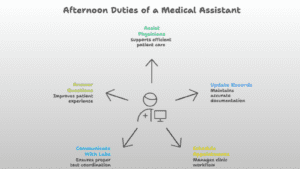
Afternoon Duties at a Glance
Similar to the morning duties, here is a quick table recap of the afternoon tasks and their purpose.
| Task | Purpose |
| Assist physicians during visits | Supports efficient patient care |
| Update medical records | Maintains accurate documentation |
| Schedule appointments | Helps manage workspace workflow |
| Communicate with labs | Ensures proper test coordination |
| Answer patient questions | Improves patient experience |
Because patient visits can vary in complexity, medical assistants must remain flexible and organized throughout the afternoon.
3. Evening
This is the wrapping up of the day and preparing for tomorrow. That’s why medical assistants focus on both administrative wrap-up tasks and workspace preparation for the next workday.
a) End-of-Day Responsibilities
Typical evening duties may include:
- Updating final patient records
- Restocking medical supplies
- Cleaning and sanitizing medical equipment
- Organizing examination rooms
- Preparing patient charts for the next day
These tasks are essential for maintaining a safe and organized healthcare environment. Plus, that’s all for a day in a medical assistant’s life.
Evening Duties at a Glance
To better understand the end-of-day responsibilities, here’s a quick summary of the main evening tasks and their purpose.

| Task | Purpose |
| Update patient documentation | Ensures accurate records |
| Restock supplies | Keeps exam rooms ready |
| Sanitize equipment | Maintains hygiene standards |
| Review next day’s schedule | Helps prepare for upcoming patients |
| Organize medical files | Improves efficiency for the next shift |
Although the pace may slow slightly compared to the morning rush, attention to detail remains important during these final steps.
Consider a clinical medical assistant the same as a medical assistant? Not exactly! Both have slightly different roles and responsibilities. Read the guide “What a Clinical Medical Assistant Does” to understand what those differences are.
Challenges and Rewards of Being a Medical Assistant
Like many healthcare careers, working as a medical assistant comes with both challenges and rewarding experiences. Understanding both sides can help aspiring professionals decide whether this role truly fits their expectations and career goals.
a) Common Challenges
Medical assistants often work in fast-paced clinical environments where responsibilities can shift quickly throughout the day. Some of the common challenges include:
- Busy work schedules: The workspace can become crowded, especially during peak hours, requiring medical assistants to manage multiple patients and tasks efficiently.
- Balancing multiple responsibilities : The role often involves handling both clinical duties and administrative work, which can sometimes feel too much to handle.
- Long or unpredictable hours : Depending on the healthcare setting, shifts may extend beyond regular working hours or involve weekend schedules. So, be prepared for such circumstances.
- Emotional situations: Medical assistants frequently interact with patients who may be anxious, in pain, or dealing with health concerns, which requires patience and emotional resilience.
While these challenges can make the job demanding at times, they also help professionals build valuable experience in the healthcare field.
| Don’t have time to complete a year-long degree? Consider enrolling in the CCI Training Center’s online medical assistant program. This program is designed to help students gain the necessary skills and training for the medical assistant role in a more flexible learning format. |
b) Rewards of the Role
Despite the challenges, many medical assistants find their work meaningful and fulfilling. Some of the most rewarding aspects of the role include:
- Helping patients directly: This is one of the most rewarding parts of being a medical assistant. By guiding patients, answering basic questions, and offering reassurance during their visit, medical assistants help reduce anxiety and make patients feel more comfortable.
- Career stability : According to the U.S. Bureau of Labor Statistics, the job outlook for medical assistants is projected to grow by 12% from 2024 to 2034, faster than the average for all occupations. With this growing demand, this role offers strong job opportunities.
- Opportunities for growth : Approximately 119,800 job openings for medical assistants are expected each year over the decade. Therefore, many medical assistants continue to advance in healthcare careers by earning additional certifications or specialized training.
Key Skills Medical Assistants Use Throughout the Day
Now that you have seen what a day in the life of a medical assistant looks like. The next step is to identify the specific skills you must possess to handle these daily responsibilities effectively.
1. Communication Skills
Medical assistants interact with patients, physicians, nurses, and administrative staff throughout the day. Therefore, they must have strong communication skills to clearly explain basic instructions to patients, collect accurate health information, and coordinate effectively with the healthcare team.
2. Organization and Time Management
The workspace can become very busy very quickly, especially during peak hours. Medical assistants must manage patient intake, documentation, physician support, and administrative tasks simultaneously. Being organized helps them prioritize responsibilities and ensure that appointments run on schedule.
3. Attention to Detail
Accuracy is extremely important in healthcare settings. Medical assistants must carefully record vital signs, update patient records, and handle documentation without errors. Even small mistakes in medical records or patient information can affect treatment decisions, which is why attention to detail is essential.
4. Empathy and Patient Care
Many patients visit the workspace when they are worried about their health. Medical assistants must show patience, empathy, and professionalism while interacting with patients. A caring attitude can help patients feel more comfortable and supported during their visit.
5. Adaptability and Problem-Solving
No two days in a workspace are exactly the same. Unexpected situations, schedule changes, or urgent patient needs can arise at any time. Medical assistants must be flexible and capable of adjusting quickly while maintaining efficiency and professionalism.
These are some of the ideal soft skills for your dream job that you must have to ensure you can easily manage a dynamic and patient-focused work environment.
Conclusion
Now that you know exactly what a day in the life of a medical assistant looks like, you are likely not as worried as you were before reading this guide. You can now move forward with greater confidence and start planning your career path. To plan the next steps effectively, it’s helpful to review this guide on how much medical assistants make to get a clear vision of your earning potential.





Providing accredited career training for decades, CCI Training Center is a name that is well recognized and trusted among employers in the fields of Information Technology, Medical / Healthcare, and Business & Accounting. At CCI Training Center, we’re proud of the tradition of excellence we established with the first class of professional career training graduates in 1984.

The experts at CCI career training center have been preparing thousands of adults for new careers or assisting them in enhancing their current careers through our fast-track online career training program.