














Summary

If you’ve been thinking about a career in healthcare, during your research, you may have noticed that medical assisting keeps coming up. That’s a great starting point; however, you may be asking yourself questions like:
Is an online medical assistant program actually worth it?
Will employers take it seriously?
Will the credential open real doors?
Those are the right questions to ask. And thankfully, in 2026, the answers are clearer than ever. This post breaks down the job market data, what makes an online program credible, what you’ll earn, and how to know whether this path is the right one for you.
Key Takeaways
|
Quick answer: Is an online medical assistant program worth it in 2026?
It is worth it when the program helps you build the skills employers actually need, includes practical training, and prepares you for certification and entry-level work. It is not worth it if it is little more than self-paced videos and a certificate with no clinical relevance.
That distinction matters. Medical assistants are expected to do much more than answer phones. They may take vital signs, prepare patients for exams, collect specimens, support EHR workflows, schedule appointments, handle insurance tasks, perform EKG-related tasks, and help the office run smoothly. A real program has to prepare you for both sides of that job.
Why More Adults Are Asking If Medical Assistant Training Is Worth It Now
In 2026, many career changers want a role that is practical, stable, and faster to enter than a four-year degree path. Medical assisting stands out because it checks several boxes at once. It is healthcare-focused, widely available across clinics and outpatient settings, and reachable through postsecondary training rather than a long academic timeline.
It also fits people who want variety. This is not a desk-only role, and it is not a patient care-only role either. If you like the idea of helping people, staying organized, and learning the workflow of a medical office, medical assisting can be a smart first move. That is one reason guides like how to become a medical assistant continue to attract interest from adults looking for a realistic path into healthcare.
Is a Medical Assistant a Good Career Choice in 2026?
Short answer, yes. But let’s look at the factors that factually prove it.
What the Job Numbers Actually Show
According to the US Bureau of Labor Statistics Occupational Outlook Handbook, employment of medical assistants is projected to grow 12% from 2023 to 2034 — a rate much faster than the average for all occupations. That growth translates to roughly 112,300 job openings every single year over the decade.
The driver behind that demand isn’t a trend; it’s demographics. You see, boomers are aging rapidly in the US, and requiring more preventive medical services, and physicians are relying on medical assistants to handle both clinical and administrative tasks so they can see more patients. Additionally, outpatient care centers, urgent care clinics, and specialty practices are all expanding their MA headcount.
All of this makes medical assisting one of the more stable entry points into healthcare right now.
What Medical Assistants Actually Do Day to Day
One of the reasons medical assisting is such a strong career choice is the variety built into the role. On the clinical side, you’ll take patients’ vital signs, record medical histories, prepare patients for examinations, administer medications, and assist with procedures. On the administrative side, you’ll schedule appointments, manage records, handle insurance documentation, and keep the office running smoothly.
That dual scope matters for two reasons. First, it makes you genuinely valuable to any healthcare facility. Second, it gives you exposure to different areas of healthcare, which is useful if you plan to specialize or advance later.
NOTE: There’s a difference between a clinical and an administrative medical assistant.
For those curious about low-stress healthcare roles that still offer meaningful patient interaction, medical assisting consistently ranks high.
Is Being a Medical Assistant a Good Career Long-Term?
Yes, because the demand mentioned before isn’t just for this month or this year. The occupational demand is driven by structural factors (aging population, expanding outpatient care, and physician productivity needs) that aren’t going away. Job security in this field is genuinely strong.
Beyond stability, there’s real room to grow. Medical assistants routinely move into specialty roles, supervisory positions, office management, medical billing, or further healthcare education. The role functions as a practical launchpad — especially for career changers who want to enter healthcare quickly and keep building from there.
What is the Pay Like?
The latest BLS data shows a median annual wage of $44,200 for medical assistants. However, it should be noted that those numbers do not mean every job pays the same. Pay varies by employer, location, shift, experience, credentials, and work setting. But the national data still shows that this is a real career field with ongoing demand, not a niche job with shrinking opportunities.
If long-term earnings matter to you, specialization can also help. Here’s a guide to the highest-paying medical assistant specialties that explains how work setting and skill mix can influence pay growth over time.
Can an Online Program Actually Prepare You for the Job?
Flexibility Without Sacrificing Rigor
One of the biggest shifts in medical assistant training over the last few years is that online programs have matured significantly. The best ones in 2026 aren’t cut-rate alternatives to in-person training — they’re structured, teacher-led learning experiences built around the same clinical competencies employers expect. You can complete coursework on a schedule that works around your current job or family commitments without sacrificing the depth of instruction you need.
That flexibility is especially valuable for career changers. You don’t have to quit your current job the day you enroll. A well-designed accelerated program lets you build the knowledge base — medical terminology, anatomy, pharmacology, EHR systems, clinical procedures — while you’re still earning income.
Are Online Medical Assistant Programs Respected by Employers?
Yes, when they’re accredited and include a clinical externship component. Employers in 2026 are not looking at where you learned — they’re looking at what you can do and what credentials you hold. According to NHA, 96% of employers require or encourage certification for medical assistants.
Please understand that it is the credential, not the campus, that moves resumes to the top of the stack.
What employers do scrutinize is whether your program was accredited and whether it included hands-on clinical training. A program that skips the externship or lacks recognized accreditation will raise red flags in an interview.
The Certification Factor — Why CCMA and CMA Credentials Matter
Two credentials dominate the medical assisting field: the Certified Clinical Medical Assistant (CCMA) offered by the National Healthcareer Association (NHA), and the Certified Medical Assistant (CMA) offered through the American Association of Medical Assistants (AAMA). Both are nationally recognized and NCCA-accredited.
The CMA (AAMA) is widely regarded as the gold-standard credential and is accepted by employers across the country. The CCMA is also respected and is particularly popular with programs that align their curriculum to NHA’s exam content. The right choice depends on your program’s alignment and your target employers — but having either credential on your resume signals to hiring managers that you’ve been trained to a verified standard.
What Separates a Worthwhile Program from a Waste of Money
Now, the main concern is how you are going to find a program that is worthwhile with your money and time. Well, just look for the following:
Accreditation Is Non-Negotiable
Not all online programs are created equal, and the fastest way to identify a credible one is to check for accreditation. Programs without recognized accreditation may leave you ineligible for top certification exams — which means ineligible for the jobs that require them. Before you enroll anywhere, confirm the accreditation status. It’s a five-minute check that can save you months of wasted effort.
For instance, the CCI Training Center is accredited by the Accrediting Council for Continuing Education & Training (ACCET), so you know you are getting the training that is verified by third-party institutions.
Teacher-Led vs. Self-Paced: What Employers Actually See
Self-paced courses have their place, but there’s a meaningful difference in outcomes when you’re learning in a structured, synchronous environment with instructor support.
Teacher-led programs hold you to a curriculum timeline, give you immediate feedback, and build the kind of discipline that translates to a clinical environment. When you sit down with a hiring manager and describe how you trained, the quality of that answer matters.
Do Online Medical Assistant Programs Include Hands-On Training?
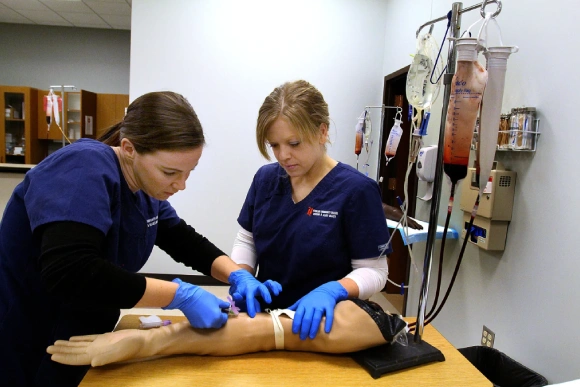
Well, the high-quality ones do, and this is a critical point. As an aspiring medical assistant, you should know that the clinical externship (typically completed at a local healthcare facility) is what bridges online coursework and real job readiness.
This is because it’s where you practice taking vital signs, processing specimens, preparing exam rooms, and working with actual patients under supervision. Employers consistently cite externship experience as one of the most important factors when evaluating new-grad applicants.
So, make sure when you evaluate any online program, ask specifically about the externship:
- How many hours?
- Is placement support included?
- What kinds of facilities do students train in?
If a program can’t answer those questions clearly, that’s your answer.
Conclusion
So, is an online medical assistant program worth it in 2026? If it’s accredited, teacher-led, includes a clinical externship, and prepares you for a nationally recognized certification, the answer is yes.
The job market is genuinely strong for MA; the credentials carry real weight with employers, and the career offers both immediate stability and long-term growth potential.
If you’re ready to take the next step, explore CCI’s online medical assistant program and see how fast you can get started.
Program Offered
- Pharmacy Technician Training
- Online Medical Assistant
- Medical Billing and Coding Specialist Program
- Cloud Computing Technician Training
- Computer Network Technician
- Business and Accounting
- Radiology Technician Training
- Medical Assistant Program
- Computer Support Technician
- Cybersecurity Program
- Virtual Assistant Training

This article is written by
Share this article
Program Offered
- Pharmacy Technician Training
- Online Medical Assistant
- Medical Billing and Coding Specialist Program
- Cloud Computing Technician Training
- Computer Network Technician
- Business and Accounting
- Radiology Technician Training
- Medical Assistant Program
- Computer Support Technician
- Cybersecurity Program
- Virtual Assistant Training
This article is written by
Share this article
Frequently Asked Questions
Is an online medical assistant program worth it if I have no healthcare background?
Yes. Most accredited online MA programs are designed for students with no prior clinical experience. The curriculum covers everything from the ground up — medical terminology, anatomy, clinical procedures, and administrative skills — so a healthcare background isn’t a prerequisite for success.
How long does an online medical assistant program take to complete?
Most accredited online programs take between four months and one year to complete, depending on the format and pace. Accelerated, fast-track programs can move you through the curriculum quickly without cutting corners on the content needed to pass your certification exam.
What certification should I get after an online medical assistant program?
The two most widely recognized credentials are the CMA (AAMA) and the CCMA (NHA). Both are nationally respected and NCCA-accredited. The right choice depends on the certification your program prepares you for — ask any program you’re considering which exam their curriculum aligns to before enrolling.
Is medical assistant a good career for someone who wants job stability?
Yes, medical assisting ranks among the more stable healthcare support roles. With 15% projected employment growth through 2034 and roughly 119,800 openings expected each year, the demand is consistent and driven by long-term factors like an aging population and expanding outpatient care — not short-term hiring cycles.
Can I get a job as a medical assistant without a college degree?
Yes. A four-year degree is not required to become a medical assistant. What employers look for is completion of an accredited training program and, in most cases, a professional certification like the CCMA or CMA. That combination is achievable in less than a year through a quality online program.
Related Articles
 Pamela Christianson
 Pamela Christianson
 Pamela Christianson
 Pamela Christianson
 Pamela Christianson

CCI Training Center Proudly Completes
41 Years in Career Training Services