














Summary
Quick Takeaways
|
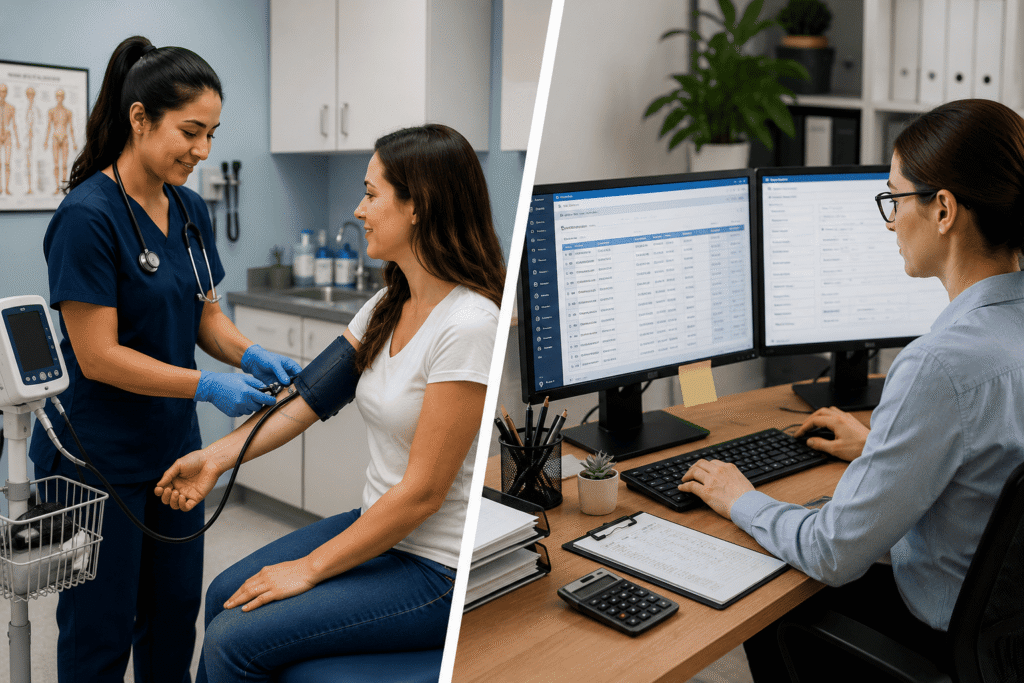
You have decided healthcare is the right direction for your career. Smart move! It’s one of the most stable, fastest-growing industries in the country. But now you are stuck between two very different paths: becoming a Medical Assistant or getting into Medical Billing and Coding, as both are solid entry points. Neither requires a four-year degree. Both are in demand. And both can get you working in healthcare in under a year.
One puts you in the exam room with patients, whereas the other puts you behind a screen, decoding diagnoses and chasing insurance claims. Worry not! This guide will cut through the noise on the medical assistant vs medical billing and coding debate and give you a clear, honest picture of what each role actually looks like.
Medical Assistant vs Medical Billing and Coding: A Complete Comparison
1. Duties and Responsibilities
Although both careers support the healthcare system, their responsibilities differ significantly. The table below provides a side-by-side comparison of what medical assistants and medical billing & coding specialists typically handle each day.
| Area of Responsibility | Medical Assistant | Medical Billing & Coding Specialist |
| Insurance Verification | ✓ Sometimes | ✓ Primary Responsibility |
| Greeting and Assisting Patients | ✓ Regularly | ✓ Occasionally |
| Taking Vital Signs | ✓ Primary Responsibility | ✗ No |
| Preparing Patients for Exams | ✓ Primary Responsibility | ✗ No |
| Assisting Physicians During Procedures | ✓ Frequently | ✗ No |
| Collecting Lab Samples | ✓ Often | ✗ No |
| Administering Medications or Injections* | ✓ In Some States and Settings | ✗ No |
| Performing ECGs / Basic Clinical Tests | ✓ Often | ✗ No |
| Front-Office Administrative Tasks | ✓ Sometimes | ✓ Frequently |
| Clinical Patient Care | ✓ Primary Responsibility | ✗ No |
| Medical Coding (ICD-10, CPT, HCPCS) | ✗ Not Typically | ✓ Primary Responsibility |
| Billing & Insurance Claims Processing | ✗ Occasionally | ✓ Primary Responsibility |
| Payment Posting & Accounts Receivable | ✗ Rarely | ✓ Frequently |
| Working Directly With Patients | ✓ Daily | ✗ Minimal to None |
| Remote Work Opportunities | ✗ Limited | ✓ Common |
| Clinical Procedures | ✓ Primary Responsibility | ✗ No |
| Data Entry & Documentation | ✓ Frequently | ✓ Primary Responsibility |
The comparison above provides a quick overview, but there’s much more to understand about each career path. Let’s break them down individually.
a)What Does a Medical Assistant Actually Do?
A Medical Assistant (MA) is the backbone of the clinical floor. They move fast, they are everywhere, and on most days, they are the first healthcare professional a patient actually interacts with. The role is genuinely hybrid. You’re not just doing clinical work or just doing admin; you are doing both, often within the same hour.
Clinical duties typically include:
- Recording vital signs (blood pressure, temperature, pulse, weight)
- Preparing exam rooms and sterilizing instruments
- Assisting physicians during examinations and minor procedures
- Drawing blood (phlebotomy) and collecting specimen samples
- Performing ECGs (Electrocardiograms)
- Administering injections and medications as directed by a physician
- Patient education and discharge instructions
Administrative duties typically include:
- Scheduling appointments and managing patient flow
- Updating Electronic Medical Records (EMR)
- Handling insurance pre-authorizations
- Processing referrals and managing patient correspondence
If you want to understand how the clinical and administrative sides of this role connect, this guide on Administrative V. Clinical V. Medical Assistant Specialists’ Career Options is a good starting point.
b) What Does a Medical Billing and Coding Specialist Do?
Medical Billing and Coding is the process of turning clinical documentation into financial transactions, and it has to be precise.
Coders review physician notes and translate every diagnosis, procedure, and service into standardized codes. Billers take those codes, submit claims to insurance companies, track payments, handle denials, and ensure the provider actually gets paid.
In smaller practices, one person often does both. In larger systems, coding and billing may be separate roles. Either way, the work is detail-heavy, compliance-driven, and mostly screen-based.
Core daily tasks include:
- Reviewing physician documentation and medical records
- Assigning ICD-10 (diagnosis) and CPT (procedure) codes accurately
- Creating and submitting insurance claims
- Tracking claim status and following up on denials
- Posting payments and reconciling accounts
- Ensuring HIPAA compliance across all documentation
- Communicating with insurance companies and patients about billing discrepancies
For a detailed walkthrough of how they work, read our step-by-step guide to the medical billing process.
2. Medical Assistant vs Medical Billing and Coding Salary
Let’s get into what most people actually want to know.
a) Medical Assistant Salary
According to the U.S. Bureau of Labor Statistics (BLS), the median annual wage for medical assistants was $44,200, which is approximately $21.25 per hour, with a projected job growth of 12% through 2034, significantly faster than the average for all occupations. Also, about 112,300 openings for medical assistants are projected each year, on average, over the decade.
To give you a clearer picture of earning potential, here’s the complete medical assistant salary breakdown using Salary.com data from June 2026:
- Top Earners (90th percentile): $54,013
- Majority Range (25th-75th percentile): $41,259 to $50,142
- Entry-Level (10th percentile): $37,043
If maximizing your earning potential is a priority, location matters. Some cities consistently offer higher salaries for medical assistants due to strong healthcare demand and competitive labor markets.
Here are the top 10 highest-paying cities for medical assistant jobs:
| City | Annual Salary | Monthly Pay | Weekly Pay | Hourly Wage |
| Corcoran, CA | $65,946 | $5,495 | $1,268 | $31.70 |
| Soledad, CA | $61,886 | $5,157 | $1,190 | $29.75 |
| Lake Los Angeles, CA | $61,195 | $5,099 | $1,176 | $29.42 |
| San Mateo County, CA | $60,895 | $5,074 | $1,171 | $29.28 |
| Mineral, VA | $60,126 | $5,010 | $1,156 | $28.91 |
| Gonzales, CA | $59,767 | $4,980 | $1,149 | $28.73 |
| Surry, VA | $59,500 | $4,958 | $1,144 | $28.61 |
| Llano, CA | $59,269 | $4,939 | $1,139 | $28.49 |
| Ione, CA | $59,255 | $4,937 | $1,139 | $28.49 |
| Elberon, VA | $59,098 | $4,924 | $1,136 | $28.41 |
Source: ZipRecruiter
Specialization can push this significantly higher. MAs working in research settings, specialty clinics, or cardiology environments tend to earn more. For a breakdown by specialty, check out the highest-paying medical assistant specialties for a full picture.
b) Medical Billing and Coding Specialist Salary
The average annual salary for a Medical Billing and Coding professional in the United States is $43,834, which works out to approximately $21 per hour. Actual earnings can vary based on factors such as experience, certifications, employer type, and geographic location.
Here’s a general overview of the medical billing and coding salary range:
- Top Earners (90th percentile): $49,121
- Majority Range (25th-75th percentile): $40,970 to $46,602
- Entry-Level (10th percentile): $38,363
Source: Salary.com
Medical billing and coding specialists’ salaries often vary by location, with certain cities offering higher pay due to increased healthcare activity, larger medical networks, and greater demand for skilled coding and reimbursement professionals. The cities below represent some of the highest-paying markets for medical billing and coding specialists in the United States.
| City | Annual Salary | Monthly Pay | Weekly Pay | Hourly Wage |
| Honolulu County, HI | $56,170 | $4,680 | $1,080 | $27.00 |
| Sitka, AK | $55,020 | $4,585 | $1,058 | $26.45 |
| Holdrege, NE | $54,709 | $4,559 | $1,052 | $26.30 |
| San Bruno, CA | $54,564 | $4,547 | $1,049 | $26.23 |
| Jewett, TX | $54,279 | $4,523 | $1,043 | $26.10 |
| Los Altos, CA | $54,089 | $4,507 | $1,040 | $26.00 |
| Mountain View, CA | $53,878 | $4,489 | $1,036 | $25.90 |
| San Francisco, CA | $53,809 | $4,484 | $1,034 | $25.87 |
| Palo Alto, CA | $53,688 | $4,474 | $1,032 | $25.81 |
| Santa Clara, CA | $53,639 | $4,469 | $1,031 | $25.79 |
Source: ZipRecruiter
Interested in the future of this career? Read our guide to learn more about the job outlook for Medical Billing and Coding Specialists.
3. Certifications You Will Need For Each
Certifications serve as proof that you have mastered the knowledge and practical skills required for your chosen career. Below, we have highlighted the most common certifications pursued by medical assistants and medical billing and coding professionals.
a) Medical Assistant Certifications
The most widely recognized credential for MAs is the Certified Clinical Medical Assistant (CCMA) offered by the National Healthcareer Association (NHA). Learn how this certification can impact your career by reading our in-depth guide on the Certified Clinical Medical Assistant (CCMA) Guide: Salary, Exam Prep, and Career Paths. Others include:
- CMA (Certified Medical Assistant) offered by the American Association of Medical Assistants (AAMA)
- NCMA (National Certified Medical Assistant) is offered by the National Center for Competency Testing (NCCT)
For a detailed breakdown of which cert makes sense depending on your program, see this guide to medical assistant certifications: CMA, RMA, CCMA, and Beyond.
b) Medical Billing and Coding Certifications
The two most recognized credentialing paths are through the AAPC and AHIMA:
- CCA (Certified Coding Associate) – AHIMA’s entry-level coding credential
- CCS (Certified Coding Specialist) – AHIMA’s advanced credential for experienced coders
- CBCS (Certified Billing and Coding Specialist) – NHA credential with a billing focus
- CPC (Certified Professional Coder) – AAPC’s flagship coding credential; widely recognized by employers. If you are considering this certification, be sure to understand the distinction between CPC-A (Apprentice) and CPC. Learn more about this in our guide on CPC-A vs. CPC: What’s the Difference?
Did you know? Earning an AAPC certification can strengthen your resume and improve your competitiveness in the job market. Individuals without certification earn an average annual salary of $53,749, while AAPC-certified professionals earn approximately $62,689 per year, an increase of 16.6% over non-certified colleagues. This highlights the value certification can bring to both career advancement and long-term earning potential.
| WORTH READING: Deciding between CBCS and CPC? Our detailed guide, “CBCS vs CPC: Which Medical Coding Certification Is Right for You in 2026?” breaks down the key differences, career paths, and certification requirements. |
4. Medical Assistant vs Medical Billing and Coding Work Environment
This is one of the most underrated factors in the whole medical billing and coding vs medical assistant decision, and it’s where people most often get it wrong.
a) Settings Where Medical Assistant Works
MAs work in:
- Physician offices and primary care clinics
- Urgent care centers
- Specialty practices (cardiology, dermatology, pediatrics, oncology)
- Outpatient surgery centers
- Community health clinics
Medical assisting is a hands-on profession where every day looks a little different. One day, you will spend time on your feet, moving between tasks and patient interactions rather than sitting behind a desk all day. The work can be demanding, but it offers something many healthcare careers value highly: the opportunity to make a visible difference in patients’ lives.
b) Areas Where Medical Billing and Coding Specialists Work
Billing and coding professionals work in:
- Hospital billing departments
- Physician group practices
- Insurance companies
- Third-party billing companies
- Fully remote (work from home)
One of the biggest advantages of a career in medical billing and coding is the growing availability of remote work. According to AAPC’s Medical Coding and Billing Salary Report, 65.7% of professionals work remotely full-time, while 14.1% work in hybrid positions. As employers continue embracing flexible work arrangements, professionals with billing and coding expertise have access to a wider range of career opportunities.
5. Medical Assistant vs Medical Billing and Coding Career Growth
The first job you land is only part of the equation. A smarter question is where that role can take you five or ten years down the road. Both medical assistants and medical billing and coding specialists have opportunities to advance, but the career paths look very different.
a) Medical Assistant Career Path
Starting as an MA, the natural progression looks like this:
- Specialized MA
- Lead or Senior MA
- Medical Office Manager
- Healthcare Administration
- Nursing or allied health
The MA role also naturally overlaps with billing knowledge, understanding the billing cycle makes you more valuable in any clinical setting. For context on how that connection works, see Why Is Medical Billing and Coding Important.
b) Medical Billing and Coding Career Path
The progression in billing and coding tends to be credential-driven:
- Entry-level coder/biller → specialized coder (oncology, cardiology, surgical)
- CPC + specialty cert → significant salary jump
- Coding auditor or compliance officer — reviewing others’ work for accuracy
- Revenue Cycle Director — senior leadership in hospital finance
Who Should Choose Medical Assisting?
You are the right fit for this path if:
- You want direct patient contact every day
- You thrive in fast-paced, unpredictable environments
- You want to keep options open for clinical progression (nursing, specialization)
- You don’t want to work from home, and you want to be somewhere with energy
- You are comfortable with physical tasks such as standing, moving, drawing blood, and assisting with procedures
You might struggle with this medical assistant path if you strongly prefer quiet, independent, screen-based work.
Who Should Choose Medical Billing and Coding?
You are the right fit for this path if:
- You prefer detail-oriented, independent work over patient interaction
- Remote flexibility matters to you, as billing and coding is one of the most genuinely remote-friendly healthcare careers
- You have strong attention to detail and enjoy working within rule sets and compliance frameworks
- You want a higher salary ceiling as you stack credentials and specialize
- You want to be in healthcare without the clinical environment
You might struggle with this medical billing and coding specialist path if you need variety, physical movement, or direct human connection to stay engaged at work.
Can You Switch Between Medical Assisting and Medical Billing & Coding?
There’s actually more crossover here than most people realize.
MAs often handle billing-adjacent tasks such as processing insurance pre-authorizations, updating EMR records in billing-ready formats, and assisting with claim prep in smaller practices. Understanding the basics of medical billing and coding makes any MA more useful in a clinical office setting.
Conversely, billing and coding professionals with a clinical background, whether from prior MA work or coursework, tend to code more accurately because they understand what actually happened during a patient encounter. Some professionals start in one role and pivot to another. The skills aren’t entirely separate. So, you can switch between a medical assistant and a medical billing and coding specialist.
What To Expect in a Medical Assistant Program?
If you are considering becoming a medical assistant, it’s important to understand what your training will actually involve. At CCI Training Center, the online Medical Assistant Program helps students build job-ready skills in as little as 7 months.
| Factor | Medical Assistant Program |
| Program Length | 30 weeks |
| Format | Online + local in-person externship |
| Externship Required | 240 hours |
| Cost | $14,700 |
If you are unsure whether to pursue a medical assistant certificate program or an associate degree, take a look at our guide, “How Long Is an Online Medical Assistant Program?” to understand why many students choose the certificate route as a faster path into the healthcare field.
| READ MORE: You can also learn more about the importance of hands-on training by reading our guide on “What Is a Medical Assistant Externship and How Do Online Students Get Hands-On Experience?“, which explains how externships work and what to expect during your clinical experience. |
What To Expect in a Medical Billing And Coding Program?
At CCI Training Center Medical Billing & Coding Specialist Program, students develop a strong understanding of medical terminology, anatomy, coding systems, compliance regulations, and revenue cycle management.
| Factor | Medical Billing & Coding Specialist Program |
| Program Length | 26 weeks |
| Format | Online + local in-person externship |
| Externship Required | 100 hours |
| Cost | $11,985 |
Not sure whether Medical Billing or Medical Coding is the better fit for your skills, interests, and career goals? Take our quick Career Quiz and discover your answer.
Conclusion
Medical assistant vs medical billing and coding isn’t really a question of which career is better. It’s a question of which one fits how you work, where you want to be, and what you want from your day.
If you want to be in a room with patients, moving, helping, and doing something tangible, medical assisting is your path. If you’d rather work independently, prefer screen-based work, and want the option to work remotely in a detail-driven role, medical billing and coding make more sense. Either way, CCI Training Center has a program built for where you are right now.
Program Offered
- Pharmacy Technician Training
- Online Medical Assistant
- Medical Billing and Coding Specialist Program
- Cloud Computing Technician Training
- Computer Network Technician
- Business and Accounting
- Radiology Technician Training
- Medical Assistant Program
- Computer Support Technician
- Cybersecurity Program
- Virtual Assistant Training

This article is written by
Share this article
Program Offered
- Pharmacy Technician Training
- Online Medical Assistant
- Medical Billing and Coding Specialist Program
- Cloud Computing Technician Training
- Computer Network Technician
- Business and Accounting
- Radiology Technician Training
- Medical Assistant Program
- Computer Support Technician
- Cybersecurity Program
- Virtual Assistant Training
This article is written by
Share this article
Frequently Asked Questions
Is medical assisting harder than medical billing and coding?
Neither career is necessarily harder, but they require different strengths. Medical assistants must learn clinical procedures and work directly with patients, while billing and coding specialists must master coding systems, insurance regulations, and documentation accuracy.
Which career can I enter faster: medical assisting or medical billing and coding?
Both careers of medical assisting and medical billing and coding can typically be entered in less than a year through certificate-based training programs. The exact timeline depends on the program structure, externship requirements, and your attendance.
Can I work remotely as a medical assistant?
Most medical assistant positions require in-person work because patient care is a core responsibility. Some administrative or virtual medical assistant roles exist, but remote opportunities are generally more common in medical billing and coding.
Do medical billing and coding specialists interact with patients?
In most cases, patient interaction is limited. Billing and coding professionals primarily work with medical records, insurance companies, claims, and reimbursement processes.
Can medical assistants transition into medical billing and coding?
Yes. Many medical assistants already perform administrative duties and understand medical terminology, which can make transitioning into billing and coding easier with additional training and certification.
Do both medical assisting and medical billing & coding specialist careers require certification?
Certification is not always legally required, but many employers prefer or prioritize certified candidates. Credentials can improve job opportunities, credibility, and earning potential in both fields.
Which role is better for introverts: medical assisting or medical billing and coding?
Many introverts prefer medical billing and coding because the work involves less direct patient interaction and more independent, detail-focused tasks. However, personality fit varies from person to person.
Is medical billing and coding good for remote work?
Yes, medical billing and coding one of the most remote-friendly healthcare careers available. According to the AAPC Salary Report, 63.7% of medical coding professionals work remotely, and that figure has been growing year over year.

CCI Training Center Proudly Completes
41 Years in Career Training Services