











Summary

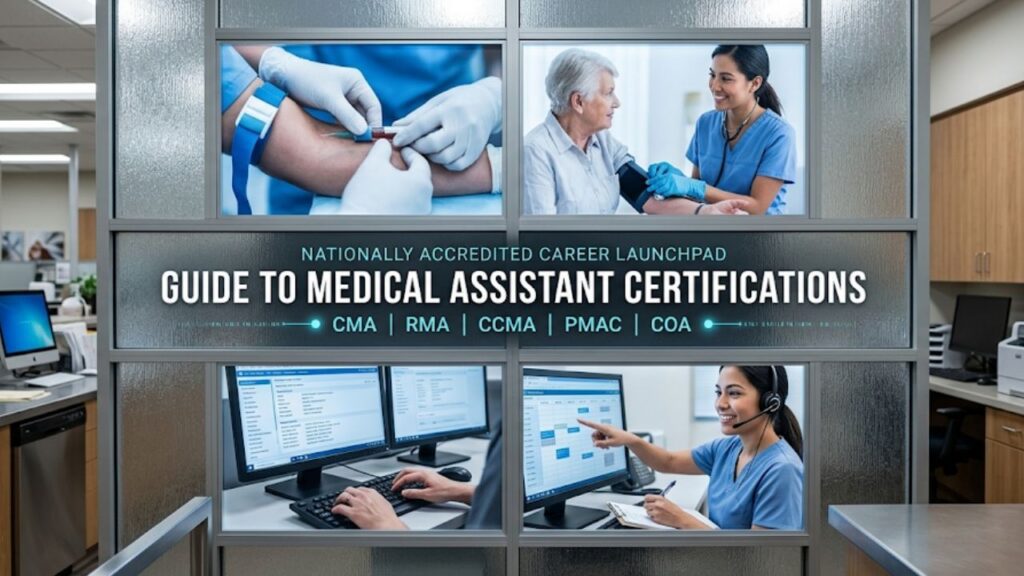
At a Glance:
|
If you are looking to enter the healthcare field quickly, becoming a Medical Assistant (MA) is one of the most strategic moves you can make. As the backbone of the modern clinic, MAs bridge the vital gap between hands-on patient care and administrative efficiency.
But as you research this path, you’ll likely encounter an alphabet soup of acronyms: CMA, RMA, CCMA, PMAC, and COA. Which one do you actually need—and is certification even necessary?
The short answer is yes. While not legally required in every state, certification is effectively your golden ticket to the industry. In fact, the National Healthcareer Association’s 2024 Industry Outlook reports that 83% of employers prefer candidates with a nationally recognized credential over those without one.
Choosing the right path depends on your goals: do you want to draw blood and take vitals, manage the front office, or keep your options open for both? Here is a comprehensive breakdown of the certs to help you decide which is right for you.
What Does a Medical Assistant Do?

Medical assistants are the vital link between doctors and patients. They keep clinics, hospitals, and outpatient centers running smoothly by handling the daily workflows that allow physicians to focus on diagnosis and treatment.
However, “Medical Assistant” is a broad title. Depending on your certification and workplace, your day-to-day role will generally fall into one of three categories:
- Clinical: Hands-on patient care, such as taking vitals, drawing blood, administering EKGs, and assisting with minor procedures.
- Administrative: Front-office operations, including scheduling, managing medical records, handling billing and coding, and acting as the primary patient liaison.
- Specialized: Working in highly focused fields like Cardiology, Dermatology, or Pediatrics (usually pursued after gaining baseline general experience).
The specific tasks you are allowed to do depend heavily on which certification you choose to pursue.
Deep Dive: Clinical vs. Administrative Roles Still deciding between the front office and the back office? Get a minute-by-minute breakdown of what to expect on the floor by reading our day-in-the-life guides on What a Clinical Medical Assistant Does and What a Medical Administrative Assistant Does. |
Do You Need to Be Certified?
If we look strictly at the law, the short answer in most of the United States is no. You can technically be hired and trained on the job without ever passing a national exam.
However, if we look at the reality of the healthcare job market, the answer is an absolute yes. Skipping certification severely limits your earning potential, your hiring prospects, and your legal scope of practice.
State Laws and the “Washington Exception”
The biggest legal factor governing your career is your local state law. Currently, Washington is the only state in the country that legally requires medical assistants to be certified to practice.
In the other 49 states, your legal boundaries are determined by “scope of practice” laws. These laws dictate exactly what a medical assistant is allowed to do. Even if a state does not require a baseline certification to get hired, it will often require specific credentials to perform high-level clinical tasks. For instance, if you want to draw blood (phlebotomy) or administer injections, a clinic will usually require you to be a Certified Clinical Medical Assistant (CCMA) through the National Healthcareer Association (NHA) to comply with state safety regulations.
Employer Preferences and Hiring Trends
Healthcare is a high-liability industry. Clinics and hospitals want proof that you know what you are doing before they let you near a patient.
As we mentioned at the start, 83% of allied health employers explicitly require or strongly prefer certified applicants. The credentials offered by the American Association of Medical Assistants (AAMA) and the American Medical Technologists (AMT) are viewed as the gold standard for verifying competence.
Here is why employers prioritize these certifications:
- The “No Experience” Workaround: If you are trying to figure out how to get a medical assistant job with no experience, passing a national certification exam is your best leverage. It proves to a hiring manager that you have a baseline understanding of HIPAA, infection control, and patient safety, drastically reducing the time they have to spend training you.
- Skill Verification: Earning a credential forces you to master important medical assistant skills that protect both the clinic from liability and the patient from harm.
- Higher Salary: Because certification assures an employer of your competence, Certified Medical Assistants (CMAs) typically earn about 10% more than their uncertified counterparts.
- Career Mobility: A certified MA has a much easier time advancing. When comparing long-term options, an LPN and medical assistant job comparison shows that many specialized clinics and transition programs (such as MA-to-LPN bridges) require an active, recognized certification as a prerequisite.
The Core Certifications Explained
If you want to be competitive, you need one of the three main certifications: the CMA, the RMA, or the CCMA. They all prove you know your stuff, but they target different career paths and have completely different rules for who is actually allowed to take the test.
Certified Medical Assistant (CMA)
Issued by the American Association of Medical Assistants (AAMA), the CMA is widely considered the gold standard in the industry.
- Focus: A balanced mix of clinical and administrative duties.
- The Catch: While it traditionally required graduation from a CAAHEP- or ABHES-accredited program, the AAMA now offers an Alternative Pathway allowing non-accredited program graduates with specific work experience to test.
- Best For: Students enrolled in formal programs or uncertified MAs looking to validate their experience with the most universally recognized credential.
Registered Medical Assistant (RMA)
Issued by the American Medical Technologists (AMT), the RMA is highly respected and offers the exact same scope of practice as the CMA, but with much more flexible entry routes.
- Focus: A balanced mix of clinical and administrative duties.
- The Catch: None. It is highly accessible. You can qualify by graduating from a program, completing a US Armed Forces program, or proving just three years of full-time medical assistant work experience within the past seven years.
- Best For: Individuals with military training or uncertified MAs who have been working in the field for years and want to make it official to secure a pay bump.
Certified Clinical Medical Assistant (CCMA)
Issued by the National Healthcareer Association (NHA), the CCMA is built for speed and direct patient care.
- Focus: Heavily skewed toward clinical, hands-on patient care tasks (vitals, phlebotomy, EKG, injections) rather than front-office paperwork.
- The Catch: It requires the most frequent renewal (every two years). You can qualify by completing a training program OR by having a high school diploma/GED plus just one year of clinical work experience.
- Best For: People who want to skip the front desk, work directly with patients, and get certified quickly.

Side-by-Side Comparison
Here is exactly what it takes to get and maintain each credential.
| Feature | CMA (AAMA) | RMA (AMT) | CCMA (NHA) |
| Primary Focus | Comprehensive (Clinical & Admin) | Comprehensive (Clinical & Admin) | Clinical (Direct Patient Care) |
| Eligibility Routes | Accredited grad OR Alternative Experience Pathway | Program grad, Military, OR 3 years of work experience | Program grad OR 1 year of work experience + HS Diploma |
| Exam Length | 200 questions (3 domains: General, Admin, Clinical) | 200 questions | 180 questions (150 scored, 30 unscored) |
| Estimated Exam Cost | ~$125 (members) – $250 (non-members) | ~$120 | ~$160 |
| Renewal Period | Every 5 years | Every 3 years | Every 2 years (~$179 fee) |
| CEU Requirements | 60 Continuing Education Units | 30 Continuing Education Units | 10 Continuing Education Units |
Exam Retake Policies
Failing an exam is frustrating, but it happens. Before you commit to a certification path, you need to know exactly how much room you have for error. Each of the above three organizations handles retakes very differently:
- CMA (AAMA) Retake Policy: You are strictly limited to three total lifetime attempts to pass the exam. You must submit a new application and pay the exam fee ($125 to $250) each time.
- RMA (AMT) Retake Policy: You are allowed up to 4 lifetime attempts. You must wait exactly 45 days between each attempt to give yourself time to study.
- CCMA (NHA) Retake Policy: You are allowed 3 attempts. You must wait 30 days after your first and second failed attempts. Warning: If you fail a third time, you are locked out for a full 12 months before you can try again.
Alternative Credentials and Niche Specializations
While the AAMA, AMT, and NHA dominate the market, they are not the only players in the healthcare industry. Depending on your background or the specific clinic you want to work in, you may encounter different acronyms.
Alternative General Certifications
If you have a highly untraditional background and do not meet the strict entry rules for the CMA or CCMA, these two organizations offer valid, recognized alternatives:
- NCMA (National Certified Medical Assistant): Administered by the National Center for Competency Testing (NCCT). This is a highly flexible alternative that accommodates diverse, on-the-job experience.
- NRCMA (Nationally Registered Certified Medical Assistant): Administered by the National Association for Health Professionals (NAHP). This credential is often favored by candidates leveraging military training or informal medical apprenticeships.
- MAC (Medical Assistant Certification): Administered by the American Medical Certification Association (AMCA), this focuses heavily on clinical and front office skills for those looking for an alternate testing route.
The Top Niche Specializations
A general MA certification gets you in the door. If you want to work in a highly specialized, higher-paying department, you will likely need a secondary, niche certification.
Here are the most valuable add-on credentials to look for once you have your baseline certification:
- PMAC (Podiatric Medical Assistant, Certified): Administered by the American Society of Podiatric Medical Assistants (ASPMA). This is mandatory if you want to assist podiatrists. It proves you can handle foot and ankle procedures, take lower-extremity x-rays, and manage specialized cast fittings.
- COA (Certified Ophthalmic Assistant): Administered by the Joint Commission on Allied Health Personnel in Ophthalmology (JCAHPO). This is the absolute gold standard for eye-care clinics. It qualifies you to administer specialized eye drops, perform vision tests, and assist ophthalmologists with minor surgeries.
- CPT (Certified Phlebotomy Technician): While a general MA certification covers basic blood draws, many high-volume labs and hospitals require a standalone CPT credential to meet specific state safety and insurance regulations.
- CET (Certified EKG Technician): Also issued by the NHA. This proves you can expertly administer cardiovascular tests (electrocardiograms) and is heavily preferred if you are applying to work in a cardiology department.
Career Outlook and Salary Expectations
Getting certified is an investment of your time, energy, and money. The immediate payoff is employability, but the long-term payoff is upward mobility. The healthcare industry is expanding rapidly, and according to the Bureau of Labor Statistics, the demand for medical assistants is projected to grow by 12% through 2034, adding over 100,000 new jobs and growing much faster than the national average.
But what does that actually mean for your bank account?
General Salary Averages and CMA Pay Bumps

As a baseline, the BLS reports that the median annual wage for a medical assistant is currently $44,200. However, this number fluctuates wildly depending on your location, your specialty, and—most importantly—your certification status.
Employers are willing to pay a premium for a turnkey employee. According to the AAMA’s 2025 Compensation Report, medical assistants with an active CMA, RMA, or CCMA credential earn an average of $45,159 annually—a built-in pay bump of nearly $2,500 over their uncertified counterparts.
Career Advancement (MA to LPN, Healthcare Administration)
For most ambitious professionals, medical assisting is not the final stop—it is the launchpad. Once you have a few years of clinical or administrative experience under your belt, your certification acts as a prerequisite for higher-paying, specialized roles.
Here are the most common ways a certified MA scales their career:
- The Nursing Route: If you thrive in direct patient care, your clinical experience is the perfect foundation for nursing. Many professionals use their credentials to transition into an MA to LPN program, cutting down the time it takes to become a Licensed Practical Nurse.
- The Management Route: If you lean toward the administrative side and want to run the clinic rather than work the floor, your next target is management. MAs frequently transition into leadership by pursuing an online healthcare administration program.
- The Executive Route: For those aiming for high-level strategic planning and budgeting, leveraging your ground-level MA experience alongside an accelerated online bachelor’s degree in healthcare administration is a highly effective way to bypass lower-level management entirely.
Maximize Your Earning Potential Securing your certification is just the baseline; where you choose to work dictates what you actually earn. Read our guide on the Highest-Paying Medical Assistant Specialties to discover which specialized clinics and research sectors are paying certified MAs upwards of $57,000 a year. |
How to Choose the Right Certification for You

The best certification for you comes down to your current education, how fast you want to work, and whether you prefer dealing with patients or paperwork.
Use this simple breakdown to make your decision:
| Certification | Primary Target/Pre-requisites | Key Benefits/Focus | Fast Track Goal | Long-Term Goals Aligned |
| CCMA (Certified Clinical Medical Assistant) | Wants to get onto the clinic floor fast; Prefers hands-on patient care; Wants a program completed in months. | Focuses on hands-on clinical skills (drawing blood, taking vitals). | Fastest way to start working on the clinic floor. | Nursing/PA school; Specialized Clinics (Pediatrics, Cardiology, Dermatology) |
| RMA (Registered Medical Assistant) | Already working as an uncertified MA for 3+ years; Received medical training in the military. | Fastest way to convert existing experience into a higher salary without more schooling. Heavily tests front-office administration, medical billing, and insurance coding. | Fastest way to raise salary with existing experience. | Clinic Management/Healthcare Administration |
| CMA (Certified Medical Assistant) | Currently enrolled in or recently graduated from a formal, accredited 1-to-2-year medical assisting program. | Most universally recognized credential; Keeps applicant highly competitive in both clinical and administrative roles. Heavily tests front-office administration, medical billing, and insurance coding. | N/A (Requires formal schooling). | Nursing/PA school; Clinic Management/Healthcare Administration; Specialized Clinics |
MA Program Questions Answered Wondering about job outlook, financial aid, or certification after training? CCI’s FAQ covers everything from hybrid/online formats to Texas job demand for your next steps. View Medical Assistant Program FAQ |
Conclusion: Starting Your Career
A medical assistant certification is more than just a certificate; it is the first step into a stable and growing field. While you have different options for how to get certified, the healthcare industry focuses most on your hands-on experience and your ability to adapt to a clinic’s needs.
By earning the credential you qualify for now, you move from studying to actually working. Once you are hired, your daily performance and your skills will be more important than which specific exam you took. Instead of waiting for the perfect moment, choose a path, set an exam date, and start your career.
 Pamela Christianson
 Pamela Christianson
 Pamela Christianson
 Pamela Christianson
 Pamela Christianson
 Pamela Christianson