














Summary
Medical Assistant vs EMT: Which Healthcare Career Is Right for You?
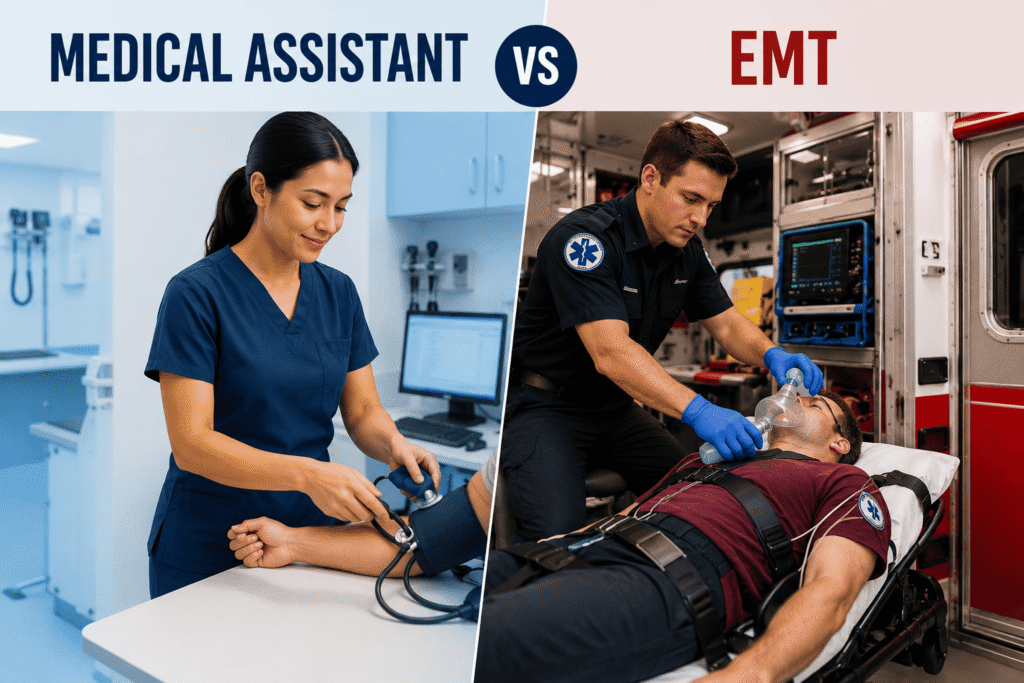
Key Takeaways:
|
Healthcare remains one of the fastest-growing employment sectors in the United States, creating thousands of opportunities for individuals seeking stable and meaningful careers. Among the many entry-level healthcare professions, Medical Assistants and Emergency Medical Technicians (EMTs) consistently attract aspiring healthcare workers because both offer relatively short training programs, direct patient interaction, and opportunities for career advancement.
However, despite sharing the goal of improving patient care, these professions differ significantly in their responsibilities, work settings, schedules, and career paths. If you are considering a future in healthcare but aren’t sure which profession aligns with your interests, use this guide to compare medical assistant vs EMT careers side by side. Here we will explain these roles across every major category, helping you discover which career better matches your preferences.
Medical Assistant vs EMT: Key Differences at a Glance
Here’s the side-by-side comparison most people searching for ” medical assistant vs EMT are really looking for. Take a quick look before we discuss each in brief:
| Factor | Medical Assistant | EMT |
| Primary work setting | Physician offices, family medicine clinics, specialty practices, urgent care centers, outpatient surgery centers | Ambulances, fire departments, hospital EDs, EMS agencies, and emergency scenes (homes, workplaces, public events, roadways) |
| Typical schedule | Regular business hours (Mon–Fri, daytime); some evening/weekend shifts at urgent care or larger facilities | 24/7 rotating shifts, including nights, weekends, and holidays; often 12- or 24-hour shifts |
| Physical demands | Low to moderate. Mostly indoor, climate-controlled settings | High (physically strenuous, unpredictable environments, indoors and outdoors in all weather) |
| Patient interaction | Ongoing; often builds long-term relationships through follow-up visits | Brief, high-intensity, single encounters during emergencies |
| Typical training length | 6–12 months (certificate/diploma) or 18–24 months (associate degree) | 150–200 hours (roughly 3–6 months) for EMT; 1–2 additional years to reach Paramedic |
| Entry requirements | High school diploma/GED, completion of an accredited MA program | 18+, high school diploma/GED, CPR/BLS certification, background check, valid driver’s license |
A) Job Responsibilities
One of the biggest differences between a Medical Assistant (MA) and an Emergency Medical Technician (EMT) is what they actually do during a typical workday. Understanding these day-to-day responsibilities is essential because they shape everything from your work environment and stress level to the skills you will use and the type of patients you will care for. Let’s take a closer look at what each profession actually does on the job.
1. What Does a Medical Assistant Actually Do on the Job?
Medical Assistants are multi-skilled healthcare professionals who play a critical role in keeping outpatient healthcare facilities running efficiently. Working primarily in physician offices, specialty clinics, urgent care centers, and other outpatient settings, they serve as the link between patients and healthcare providers. Their day is often split between providing direct patient care and managing administrative responsibilities that support the entire medical practice.
Unlike many healthcare roles that focus on a single area, Medical Assistants are trained to handle both clinical and administrative tasks. Take a look below to know what type of clinical duties are performed on the job.
Clinical Duties
Medical Assistants support physicians by performing a variety of hands-on clinical tasks, including:
- Recording vital signs (blood pressure, pulse, temperature, height, and weight)
- Collecting patient medical histories and documenting symptoms
- Preparing exam rooms and sterilizing equipment
- Drawing blood, collecting lab specimens, performing EKGs, and administering injections (where permitted)
- Assisting physicians during exams and minor procedures, such as wound care and suture removal
If you enjoy the clinical side of Medical Assisting, you can choose to pursue a career as a Clinical Medical Assistant. Before you make your mind up, take some time and read about their daily responsibilities in brief in our guide on What Does a Clinical Medical Assistant Do? A Full Career Overview.
Administrative Duties
Medical Assistants also handle essential front-office responsibilities that help healthcare facilities operate efficiently. These may include:
- Scheduling appointments, follow-up visits, and diagnostic procedures
- Greeting patients, verifying insurance, and updating electronic health records (EHRs)
- Answering phone calls, responding to inquiries, and coordinating communication between patients and the provider
- Managing medical records, documenting patient information accurately, and maintaining confidentiality
- Processing insurance forms, billing information, referrals, and patient payments
If the front-office side of healthcare appeals to you more than clinical patient care, consider a career as a Medical Administrative Assistant. Learn more about these duties by reading our guide, Medical Administrative Assistant: What They Do in a Day.
| NOTE: The responsibilities listed above are examples of typical Medical Assistant duties. Your day-to-day tasks may differ based on your employer, state laws, certifications, and the type of healthcare facility where you work. |
2. What Does an EMT Actually Do on the Job?
Emergency Medical Technicians (EMTs) are frontline healthcare professionals trained to provide immediate medical care during emergencies. Unlike medical assistants, who typically work in clinics and physician offices, EMTs respond to 911 calls and deliver care wherever a medical emergency occurs, whether it’s at a home, workplace, public event, or accident scene.
Their primary responsibility is to quickly assess patients, stabilize their condition, and transport them safely to a hospital or other healthcare facility. Because every emergency is different, EMTs must remain calm under pressure, think critically, and make rapid decisions while following established emergency care protocols.
Some of the most common responsibilities of an EMT include:
- Responding to emergency calls and assessing patients at the scene
- Administering basic life support (BLS), including CPR and AED use
- Controlling bleeding, treating wounds, and immobilizing fractures or spinal injuries
- Assisting patients experiencing heart attacks, strokes, breathing difficulties, allergic reactions, or other medical emergencies
- Administering certain medications within their scope of practice, as permitted by state protocols
- Safely transporting patients to hospitals while continuously monitoring their condition
- Communicating patient information to emergency department staff to ensure a smooth transition of care
- Completing patient care reports and documenting emergency services provided
- Inspecting, cleaning, and restocking ambulances and emergency medical equipment after each shift
| NOTE: These are common EMT responsibilities. Exact duties vary depending on the employer, state regulations, certification level (EMT, Advanced EMT, or Paramedic), and local emergency medical service (EMS) protocols. |
B) EMT vs Medical Assistant Salary
Salary is often one of the first factors people consider when choosing a healthcare career. While pay is important, it’s equally essential to understand what influences earning potential, such as experience, geographic location, employer, certifications, and work setting. Medical Assistants and EMTs have different salary ranges, and each profession offers opportunities to increase earnings over time. Let’s compare what you can expect to earn in each role.
1. Medical Assistant Salary
According to the U.S. Bureau of Labor Statistics, the median annual wage for medical assistants is $44,200. That’s the national midpoint. Half of MAs earn more, half earn less, and your actual earnings will vary by location, certification, and workplace setting.
On the growth side, the BLS reports that employment of medical assistants is projected to grow 12 percent from 2024 to 2034, much faster than the average for all occupations, with roughly 112,300 openings projected each year over the decade. That growth is driven largely by an aging population that needs more routine care and a healthcare system leaning more heavily on outpatient clinics.
2. EMTs’ Salary
According to the U.S. Bureau of Labor Statistics, the median annual wage for emergency medical technicians is $41,340. So the answer to “Do EMTs earn more?” really depends on which level of EMS certification you are comparing.
On growth, the BLS projects that overall employment of EMTs and paramedics will grow 5 percent from 2024 to 2034, faster than the average for all occupations, and the OOH page notes that about 19,000 openings for EMTs and paramedics are projected each year, on average, over the decade, many of them from workers transferring occupations or leaving the workforce.
C) Education and Time Duration
If time-to-paycheck matters to you (and for most career changers, it does), this “How Long Does It Take to Become a Medical Assistant vs an EMT?” comparison matters more than the salary numbers.
1. Medical Assistant
Becoming a medical assistant takes between a few months and two years. The timeline depends on the path you choose. There are two popular paths available:
- Certificate or Diploma MA Programs: These take 6 to 12 months. They are the fastest way to get hired.
- Associate MA Degrees: These take 18 to 24 months. They take longer but can lead to higher pay.
Confused about which path is better? Read our guide on Medical Assistant Certificate vs. Degree: Which One Should You Choose? to compare both pathways. So, first finish high school or get a GED. Next, complete the quality program and choose to take a nationally recognized certification exam.
Earning a credential like the CCMA (Certified Clinical Medical Assistant) from the National Healthcareer Association or the CMA (Certified Medical Assistant) from the American Association of Medical Assistants proves your skills. It can make it much easier to get a job. To get a full breakdown of which credential makes sense for your goals, the Medical Assistant Certifications: CMA, RMA, CCMA, and Beyond guide is a helpful next read.
2. Emergency Medical Technician
To become an EMT, you must be at least 18 with a high school diploma. Complete an accredited 150-to-200-hour training course, pass a CPR certification, and clear the NREMT cognitive and psychomotor exams. Finally, apply for your specific state license to start working.
Here is the exact step-by-step path to becoming an EMT:
Step 1: Meet the Basic Prerequisites
Before starting, you must meet a few baseline requirements:
- Age: Be at least 18 years old.
- Education: Hold a High School Diploma or GED.
- Background: Pass a criminal background check and drug screening.
- Driver’s License: Have a valid state driver’s license (needed to drive an ambulance).
Step 2: Get CPR Certified
You must hold a valid Healthcare Provider CPR or BLS (Basic Life Support) certification before entering an EMT program. You can get this through the American Heart Association or the American Red Cross.
Step 3: Complete an EMT Training Program
Find a state-approved program at a local community college, vocational school, or fire academy.
- Duration: Courses usually take 3 to 6 months.
- Curriculum: You will learn basic life-saving skills like CPR, how to use an AED (defibrillator), oxygen administration, and how to stop severe bleeding.
Step 4: Pass the NREMT Exam
Most US states require you to pass the National Registry of Emergency Medical Technicians (NREMT) exams.
- Cognitive Exam: A computer-adaptive test assessing your medical knowledge.
- Psychomotor Exam: A hands-on practical test showing you can perform life-saving skills.
- To register, submit an application through the NREMT Website.
READ MORE: If you have completed or are currently enrolled in an EMT education program and are applying for EMT certification, read this guide to learn about the requirements you need to meet.
Step 5: Obtain State Licensure
Passing the NREMT exam does not automatically give you the right to work. You must apply directly to your state’s EMS regulatory office to receive your official state license or certification.
Quick Answer: can an EMT be a medical assistant? This is one of the most common questions people ask. The short answer: yes, and it’s a genuinely common transition. But “yes” comes with a “how.” Transferable Skills Between the Two Roles EMTs already bring real advantages into a medical assisting role, including:
What Additional Training Would You Need? Where EMTs typically need to fill gaps is on the administrative and outpatient-specific clinical side of medical assisting: scheduling systems, EHR software, insurance verification, phlebotomy technique for outpatient labs, and the specific certification exam content (CMA or CCMA) that outpatient employers look for. CCI Training Center Online Medical Assistant Program is built to bridge exactly that gap. You are not starting from zero, but you are building the specific clinic-ready skill set that hiring managers expect to see on a resume. If you are weighing this move because ambulance shift work isn’t sustainable in the long term, or you want steadier daytime hours without leaving hands-on patient care, this crossover path is one of the more practical options in healthcare. |
D) Career Opportunities
One of the advantages of both Medical Assistant and EMT careers is the variety of employment opportunities available. However, the types of employers and healthcare settings differ considerably.
1. Medical Assistant Career Opportunities
Medical Assistants primarily work in outpatient healthcare settings, where they support physicians and other healthcare providers with both clinical and administrative tasks. As healthcare continues shifting toward outpatient care, Medical Assistants are needed across a wide range of specialties.
Common employers include:
- Family medicine and primary care clinics
- Pediatric practices
- Internal medicine offices
- Cardiology, dermatology, and orthopedic clinics
- OB/GYN and women’s health centers
- Urgent care centers
- Outpatient surgery centers
- Specialty physician practices
- Chiropractic and rehabilitation clinics
- Community health centers
Because medical assistants are trained in both patient care and office operations, they have the flexibility to work in many different medical specialties throughout their careers.
2. EMT Career Opportunities
EMTs provide emergency medical care in a variety of fast-paced environments. While many people associate EMTs with ambulances, their skills are needed in several healthcare and public safety settings.
Common employers include:
- Ambulance services
- Fire departments
- Hospital emergency departments
- Emergency Medical Services (EMS) agencies
- Private medical transportation companies
- Industrial and manufacturing facilities
- Airports and transportation hubs
- Colleges, universities, and school districts
- Sports venues, concerts, and public events
- Government and military organizations
As EMTs gain experience and additional certifications, they may qualify for specialized emergency response roles or leadership positions within EMS organizations.
E) Work Environment and Schedule
While both Medical Assistants and EMTs provide direct patient care, where they work and when they work can look very different. Your preferred work environment and schedule can have a major impact on your job satisfaction, work-life balance, and long-term career choice.
1. Medical Assistant Work Environment & Schedule
Medical Assistants primarily work in outpatient healthcare settings, such as physician offices, family medicine clinics, specialty practices, urgent care centers, and outpatient surgery centers. These workplaces are generally organized, climate-controlled, and focused on scheduled patient appointments rather than medical emergencies. Because many patients return for follow-up visits, Medical Assistants often build long-term relationships with the people they care for.
In terms of scheduling, Medical Assistants typically work regular business hours, such as Monday through Friday during the day. Some employers, particularly urgent care centers, specialty clinics, or larger healthcare organizations, may require evening or weekend shifts, but overall, the schedule is usually predictable. This makes Medical Assisting an attractive career for those seeking a stable routine and better work-life balance.
2. EMT Work Environment & Schedule
EMTs work in dynamic and unpredictable environments, providing emergency medical care wherever it is needed. Instead of staying in one location, they may respond to calls at homes, businesses, schools, highways, sporting events, or other public places. Many EMTs are employed by ambulance services, fire departments, hospitals, or Emergency Medical Services (EMS) agencies. Because no two emergency calls are alike, every shift presents new challenges and requires the ability to adapt quickly.
Unlike medical assistants, EMTs provide care 24 hours a day, seven days a week, which means their schedules often include rotating shifts, overnight hours, weekends, and holidays. Many EMTs work 12-hour or 24-hour shifts, depending on their employer. While this schedule can be physically and mentally demanding, some professionals appreciate having multiple consecutive days off after working longer shifts.
Which Career Fits Your Personality and Lifestyle? EMT vs Medical Assistant
Numbers aside, the right choice usually comes down to how you want your workday to feel.
Choose Medical Assistant If You Want…
- A predictable, mostly daytime schedule
- Ongoing relationships with the same patients over time
- A mix of clinical and administrative variety
- A faster, lower-cost training path with strong job availability
- A stepping stone toward nursing, medical billing and coding, or healthcare administration
Choose EMT If You Want…
- Fast-paced, high-adrenaline work
- A clear path toward Paramedic, Fire/Rescue, or flight medicine
- To be the first responder when someone needs help most
- Shift-based scheduling (which can mean more days off in a row)
- A stepping stone toward nursing, PA school, or EMS leadership roles
Final Thoughts
Both medical assisting and EMS work are legitimate, respected ways to start a healthcare career without a four-year degree. If you want steady hours, close patient relationships, and a fast track into a clinic environment, a medical assistant is the more practical fit. If you are drawn to emergency response and don’t mind irregular hours and physically demanding shifts, an EMT career may suit you better. You don’t need prior healthcare experience to start either path. So, think, compare, and decide!
Program Offered
- Pharmacy Technician Training
- Online Medical Assistant
- Medical Billing and Coding Specialist Program
- Cloud Computing Technician Training
- Computer Network Technician
- Business and Accounting
- Radiology Technician Training
- Medical Assistant Program
- Computer Support Technician
- Cybersecurity Program
- Virtual Assistant Training

This article is written by
Share this article
Program Offered
- Pharmacy Technician Training
- Online Medical Assistant
- Medical Billing and Coding Specialist Program
- Cloud Computing Technician Training
- Computer Network Technician
- Business and Accounting
- Radiology Technician Training
- Medical Assistant Program
- Computer Support Technician
- Cybersecurity Program
- Virtual Assistant Training
This article is written by
Share this article
Frequently Asked Questions
Is becoming a medical assistant harder than becoming an EMT?
Not harder, just different. Medical assistant programs cover a broader mix of clinical and administrative content over a longer timeline, while EMT-Basic training is shorter but intensely focused on emergency skills, tested through both a written and a hands-on exam administered by the NREMT.
Do medical assistants make more money than EMTs?
It depends on the level. Per the BLS, the median MA salary ($44,200) is higher than the median EMT salary ($41,340). However, actual earnings for both careers can vary based on factors such as experience, geographic location, employer, certifications, specialty, and work schedule.
Can an EMT become a medical assistant without starting over completely?
Yes. EMTs already carry patient-care experience, CPR/BLS certification, and comfort with clinical terminology. Most only need to complete a focused medical assisting program and certification exam (CMA, RMA, or CCMA) to make the switch.
Which job is more stressful, a medical assistant or an EMT?
For most people, EMTs have a more stressful job than Medical Assistants. EMTs regularly respond to medical emergencies, accidents, and other unpredictable situations where they must make quick decisions and provide immediate care under pressure. They may work long or overnight shifts and frequently encounter physically and emotionally demanding situations. Medical Assistants, on the other hand, typically work in outpatient clinics or physician offices with more predictable schedules and responsibilities.

CCI Training Center Proudly Completes
41 Years in Career Training Services