














Summary
Quick Takeaways:
|
The life of an OB/GYN medical assistant differs from that of a general MA. Ask ten different OB/GYN medical assistants what a “typical day” looks like, and you will get ten different answers, not because the job lacks structure, but because the structure itself is built around unpredictability.
- One patient needs a routine annual exam that takes ten minutes.
- The next needs an emergency same-day visit for concerning symptoms in mid-pregnancy.
- A third is nervously waiting on lab results that will determine her next fertility treatment step.
An OB/GYN medical assistant moves fluidly between all three, often within the same hour. If you have been considering becoming an OB/GYN or a fertility medical assistant, this blog will ensure that by the time you finish reading, you understand what a fertility medical assistant actually does on a day-to-day basis. Read on to get the detailed breakdown
What Is an OB/GYN Medical Assistant?
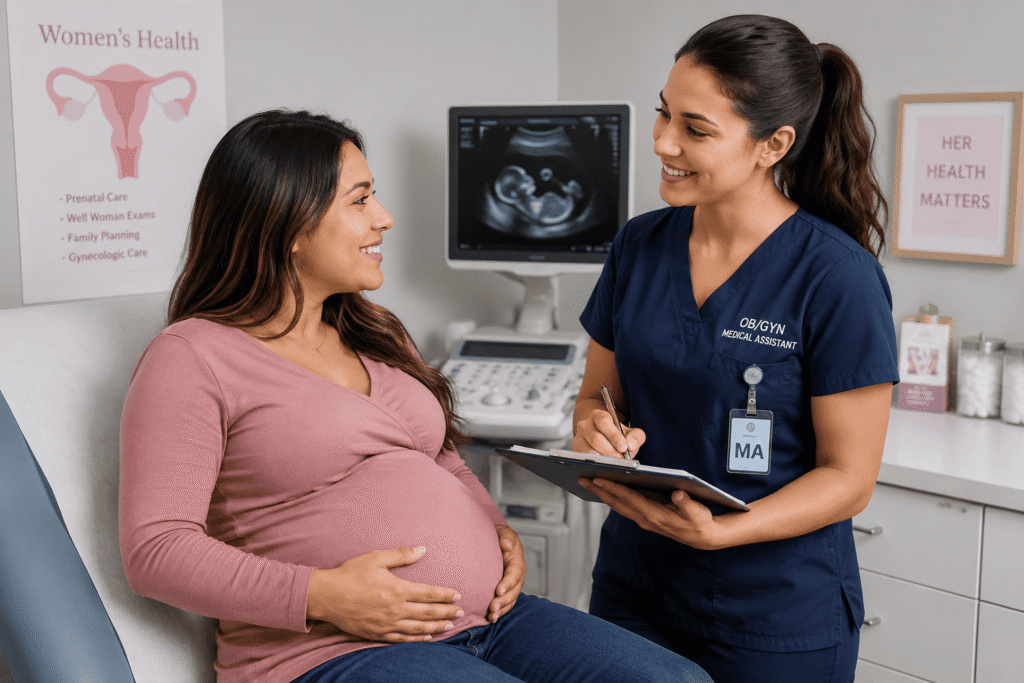
An OB/GYN medical assistant is a trained healthcare professional who works under the supervision of licensed obstetricians and gynecologists in women’s health clinics, hospitals, fertility centers, and private practices.
They support obstetricians and gynecologists in providing care across the full spectrum of women’s reproductive health, from adolescence through menopause, and everything in between, including pregnancy and childbirth. The scope of practice for OB/GYN medical assistants varies depending on state regulations and employer policies.
Because they work closely with patients during important and often emotional life events, such as pregnancy, infertility treatment, or routine reproductive care, strong communication, empathy, professionalism, and attention to detail are essential.
Do I Need Any Additional Certification to Become An OB/GYN MA?
No additional certification is strictly required to become an OB/GYN Medical Assistant (MA). A standard high school diploma, completion of a Medical Assistant certificate or diploma program, and a relevant credential such as Certified Medical Assistant (CMA) are your baseline. While not legally mandatory in every region, obtaining a general MA credential is highly recommended to prove your foundational skills. The most respected certifications include:
- CMA (Certified Medical Assistant): Awarded by the American Association of Medical Assistants (AAMA).
- RMA (Registered Medical Assistant): Administered by American Medical Technologists (AMT).
- CCMA (Certified Clinical Medical Assistant): Issued by the National Healthcareer Association (NHA).
Once you meet the requirements to become an OB/GYN medical assistant, you can pursue opportunities in this specialty. According to ZipRecruiter, the average annual pay for an OB/GYN medical assistant in the United States is approximately $41,370.
What Do OB/GYN Medical Assistants Do on a Daily Basis?
Understanding what an OB/GYN or fertility medical assistant actually does day-to-day means going beyond a simple list of tasks. Although the daily responsibilities vary by employer and state regulations, most perform the following tasks.
1. Morning: Setting the Pace for a Precisely Timed Day
Mornings are rarely just “busy” in the generic sense; instead, they are busy in a way shaped by biology itself, regardless of setting. In a hospital, that might mean a full unit of antepartum patients needing rounds before shift change. In a private practice or fertility center, it means prenatal visits and cycle-monitoring appointments clustering early, since hormone levels and fetal measurements are most reliably tracked at consistent times of day.
a) Typical Morning Responsibilities
Before the first patient is seen, OB-GYN medical assistants prepare the setting environment and confirm the day’s logistics, whether that’s a hospital unit, a private practice, or a fertility center:
- Reviewing the day’s schedule, with special attention to any fertility patients whose visit timing is dictated by their menstrual cycle
- Preparing exam rooms, ultrasound rooms, or patient bays depending on the setting
- Confirming phlebotomy and specimen-collection supplies are stocked and ready
- Logging into the facility’s electronic health record (EHR) system and organizing patient charts
- Verifying insurance details, which can be more complex in fertility care since coverage for reproductive treatments varies significantly by state and insurer
b) Patient Intake Tasks
Once patients arrive, whether checking into a hospital unit, a private practice waiting room, or a fertility center, the focus shifts to gathering accurate clinical information before the physician steps in:
- Greeting patients and confirming personal and insurance information
- Recording vital signs such as blood pressure, temperature, pulse, and weight
- Taking menstrual cycle history, pregnancy history, and, for prenatal patients, measuring fundal height and recording fetal heart tones
- Drawing blood for hormone panels, prenatal labs, or fertility monitoring
- Updating patient charts with new information before the physician sees the patient
2. Afternoon: Where Procedures, Education, and Paperwork Collide
By the afternoon, the day shifts from information gathering to hands-on procedures and patient education, and this is where the setting really starts to differentiate the work. A hospital-based OB-GYN medical assistant may assist across labor and delivery, antepartum, or outpatient surgical units within the same system. An OB-GYN MA in a private practice or fertility center typically works within a narrower, more consistent set of procedures tied to that specific practice.
a) Patient Care Support
- Assisting physicians during pap smears, pelvic exams, or in-office procedures such as IUD insertion or removal
- Preparing patients for ultrasounds and assisting with positioning
- Teaching patients how to self-administer fertility medications and injections, often for the very first time
- Preparing lab specimens for hormone testing or genetic screening, and ensuring they’re properly labeled and routed
Medication teaching deserves particular attention and occurs across every setting where fertility treatment is offered, including private clinics, hospital-affiliated reproductive endocrinology programs, and standalone fertility centers. Fertility protocols frequently require patients to self-inject hormones on a strict schedule, sometimes for weeks at a stretch. A clear, calm walkthrough from a medical assistant often makes the difference between a patient following the protocol correctly and a patient missing a dose out of fear or confusion.
b) Administrative Responsibilities
- Updating EHRs with cycle-day details, hormone results, and physician notes in both hospital systems and private-practice software requires the same precision.
- Scheduling follow-up cycle-monitoring visits, timed precisely around a patient’s hormone levels
- Coordinating with outside labs on time-sensitive fertility test results
- Processing insurance authorizations for treatments, which can involve significant back-and-forth given inconsistent coverage rules
- Answering patient calls about medication timing, side effects, or next steps
All of this documentation is subject to strict federal privacy rules, regardless of the setting. Reproductive health information is protected under HIPAA, and the U.S. Department of Health and Human Services has explicitly reinforced that reproductive health records, including fertility treatment details, are subject to the same rigorous confidentiality protections as any other sensitive medical information.
3. Evening: Closing the Loop on a Day That Doesn’t Fully Stop
The final block of the day is less about patient-facing work and more about making sure nothing falls through the cracks before tomorrow, a task shared across hospital units, private practices, and fertility centers alike, even though hospital shifts may extend into evenings and overnight in a way a private practice typically doesn’t.
a) End-of-Day Responsibilities
- Finalizing patient records, including hormone levels and cycle-day notes
- Restocking phlebotomy and injection supplies
- Sanitizing exam and procedure rooms or hospital patient areas
- Confirming next-day cycle-monitoring appointments based on incoming lab results
- Preparing charts for tomorrow’s prenatal and fertility visits
Conclusion
OB/GYN and fertility medical assisting is one of the most rewarding specialties in healthcare, but it is also one of the most emotionally and clinically demanding. Every day brings new experiences. If this specialty feels like the right fit, remember that every experienced OB/GYN medical assistant started with the same foundation: learning the core clinical and administrative skills required of every medical assistant.
You don’t have to jump straight into a specialty practice. Many medical assistants begin their careers as a general MA, where they build confidence in patient care, vital signs, injections, EHR documentation, and medical office procedures before moving into a specialized role like an OB/GYN medical assistant. Whether your long-term goal is to work in an OB/GYN clinic, a fertility center, a hospital, or another healthcare specialty, starting with a comprehensive Medical Assistant Program at CCI Training Center gives you the knowledge and confidence to begin your healthcare career.
Program Offered
- Pharmacy Technician Training
- Online Medical Assistant
- Medical Billing and Coding Specialist Program
- Cloud Computing Technician Training
- Computer Network Technician
- Business and Accounting
- Radiology Technician Training
- Medical Assistant Program
- Computer Support Technician
- Cybersecurity Program
- Virtual Assistant Training

This article is written by
Share this article
Program Offered
- Pharmacy Technician Training
- Online Medical Assistant
- Medical Billing and Coding Specialist Program
- Cloud Computing Technician Training
- Computer Network Technician
- Business and Accounting
- Radiology Technician Training
- Medical Assistant Program
- Computer Support Technician
- Cybersecurity Program
- Virtual Assistant Training
This article is written by
Share this article
Frequently Asked Questions
Where do OB/GYN medical assistants work?
OB/GYN medical assistants can work in women’s health clinics, private OB/GYN practices, hospitals, fertility clinics, reproductive endocrinology centers, outpatient surgery centers, and other healthcare facilities specializing in women’s reproductive health.
What skills are important for an OB/GYN medical assistant?
Successful OB/GYN medical assistants need strong communication, empathy, attention to detail, organizational skills, professionalism, EHR documentation skills, phlebotomy knowledge (where permitted), and the ability to support patients during emotionally sensitive situations, such as pregnancy, infertility treatment, and reproductive health procedures.
Can medical assistants work in fertility clinics?
Yes. Many fertility clinics hire trained medical assistants to support reproductive endocrinologists and fertility specialists. Their responsibilities may include coordinating appointments, preparing patients for ultrasounds, drawing blood for hormone testing, educating patients about fertility medications, documenting treatment cycles, and assisting with administrative tasks.
Do OB/GYN medical assistants assist during procedures?
Yes. Depending on state regulations and employer policies, OB/GYN medical assistants may assist physicians during pelvic exams, Pap smears, IUD insertions or removals, ultrasounds, specimen collection, and other in-office procedures while ensuring patient comfort and maintaining sterile techniques.
Can a general medical assistant transition into an OB/GYN specialty?
Yes. Many medical assistants start in family medicine, internal medicine, or urgent care before moving into OB/GYN practices. Building a strong foundation in patient care, injections, vital signs, medical documentation, and clinical procedures makes transitioning into this specialty much easier.

CCI Training Center Proudly Completes
41 Years in Career Training Services