














Summary
What Does a Cardiology Medical Assistant Do? Duties, Skills, and Work Setting
Key Takeaways:
|
Cardiology remains one of the busiest medical specialties due to the growing number of patients seeking treatment for heart disease, hypertension, arrhythmias, and other cardiovascular conditions. According to the Centers for Disease Control and Prevention (CDC), one person dies every 34 seconds from cardiovascular disease in the United States. As patient volumes continue to rise, the demand for cardiovascular services is expected to grow significantly in the coming years.
Even the number of cardiovascular surgeries, which was recorded at 10,581 cases in 2014, is predicted to increase consistently to reach a demand of 15,501 cases in 2040. This is an increase of 46.5%.
As the need for cardiac care continues to expand, so does the demand for trained cardiology medical assistants who support cardiologists and cardiovascular specialists in diagnosing, treating, and monitoring patients with heart-related conditions. If you are considering a career in this growing specialty, understanding the role is the first step. Read this guide to explore what a cardiology medical assistant does, the skills required for success, and the healthcare settings where these professionals work.
What Does a Cardiology Medical Assistant Do? Key Duties
The day-to-day responsibilities of a cardiology medical assistant span two main areas: clinical duties and administrative tasks. Both are equally important to keeping a cardiology practice running smoothly.
1. Clinical Duties
This is where the cardiology MA earns their specialty title. Clinical responsibilities require hands-on skills and a solid understanding of cardiac diagnostics:
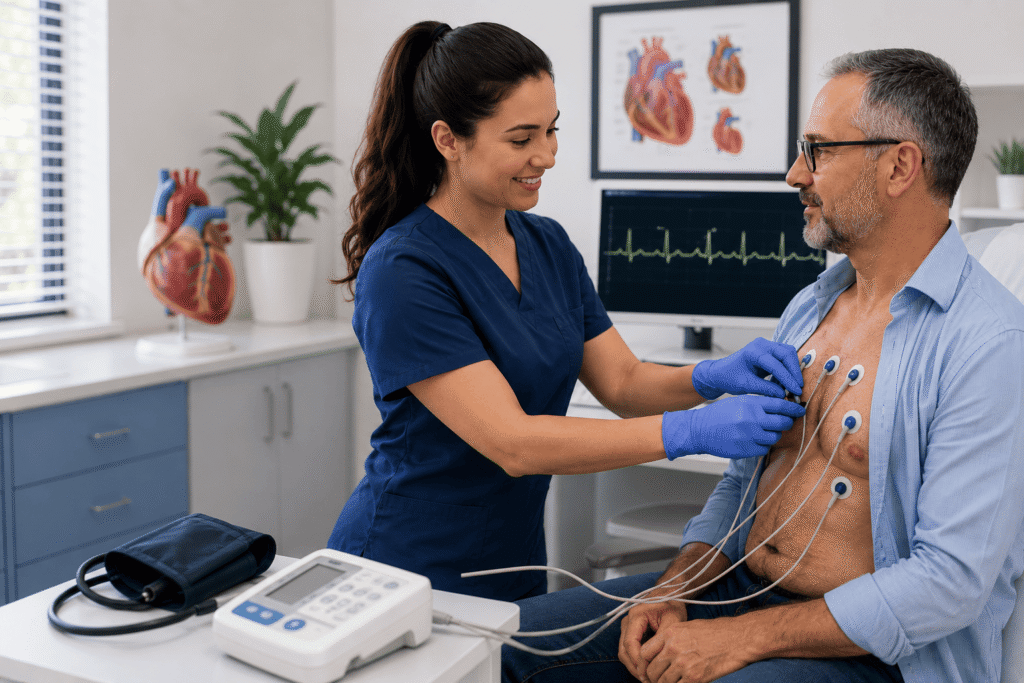
- Performing EKGs (Electrocardiograms): One of the most defining duties of a cardiac medical assistant. Cardiac medical assistants place electrodes on the patient’s chest and limbs, run the test, and produce a reading for the cardiologist to interpret. Different types of EKGs, including 12-lead EKGs and Holter monitor setups, are commonly used in cardiology settings.
- Assisting with Stress Tests: A cardiac stress test evaluates how the heart performs under physical exertion. The cardiac medical assistant monitors the patient on a treadmill, records vital signs at each interval, and ensures safety throughout the procedure.
- Monitoring and Recording Vital Signs: Blood pressure, heart rate, pulse, and respiration are tracked with extra precision in cardiology settings, where even small changes can signal serious problems.
- Phlebotomy and Specimen Collection: Cardiology patients often require frequent blood draws. A cardiology medical assistant must be comfortable with phlebotomy and specimen handling, as many cardiac patients have small or fragile veins.
- Preparing Exam and Procedure Rooms: Sterilizing equipment, restocking supplies, and ensuring rooms are ready for procedures before and after each patient visit.
- Assisting During Procedures: In cardiac catheterization labs and invasive procedure settings, the cardiology medical assistant may pass instruments, monitor patients, and help maintain a sterile environment during complex procedures.
2. Administrative Duties
While clinical skills are important, a cardiology medical assistant must also develop strong administrative skills to keep a busy cardiology practice running efficiently.
- Appointment Scheduling & Time Management: Cardiology clinics often manage high patient volumes, follow-up visits, diagnostic testing appointments, and urgent consultations. Medical assistants in cardiology must coordinate provider schedules, avoid booking conflicts, and ensure patients receive timely care while maintaining smooth daily operations.
- Medical Billing & Insurance Verification: A cardiology medical assistant should understand basic medical billing procedures, insurance verification processes, prior authorizations, and referral requirements. Accurate billing information helps reduce claim denials, prevents delays in treatment, and supports efficient reimbursement.
- Electronic Medical Records (EMR) Management: Modern cardiology practices rely heavily on EMR systems. Medical assistants must accurately document patient histories, medications, test results, physician notes, and treatment plans while maintaining compliance with HIPAA and patient privacy regulations.
- Answering Patient Calls: A cardiology medical assistant serves as an important communication link between patients and the healthcare team. They answer questions about appointments, medications, test preparations, and follow-up visits. They may also assist with prescription refill requests, relay messages to providers, and help coordinate ongoing patient care.
Essential Soft Skills for a Successful Cardiology Medical Assistant
Technical knowledge is important, but strong soft skills often make the biggest difference in long-term career success. Here are the essential qualities every cardiology medical assistant should develop:
- Communication Skills: Cardiology medical assistants interact with patients, physicians, nurses, and insurance providers throughout the day. Clear communication helps prevent misunderstandings and improves patient care.
- Attention to Detail: Small errors in patient records, test results, or medication information can have serious consequences. Accuracy is essential in cardiology settings.
- Empathy and Patient Care: Many cardiac patients experience anxiety about their condition. A compassionate and professional approach helps patients feel comfortable and supported.
- Organization and Time Management: Managing appointments, test schedules, patient records, and administrative tasks requires strong organizational abilities and the ability to prioritize responsibilities effectively.
- Teamwork: Cardiology medical assistants work closely with cardiologists, nurses, technicians, and administrative staff. Strong collaboration skills contribute to efficient workflows and better patient outcomes.
Want to develop the soft skills employers value most? Read our guide to the soft skills that make you a successful medical assistant.
Where Do Cardiology Medical Assistants Work?
Cardiology medical assistant jobs are available across several healthcare settings. Where you work also affects how much you earn. Cardiac MAs in hospital settings and catheterization labs typically earn more than those in smaller outpatient clinics, reflecting the added complexity of their responsibilities.
| Work Setting | What to Expect |
| Offices of Physicians | Regular business hours, patient interactions, EKG testing, vital signs monitoring, scheduling, and administrative support. |
| General Medical and Surgical Hospitals (Cardiac Care Units) | May include nights/weekends, faster-paced, more complex patient cases |
| Outpatient Care Centers | Diagnostic focus, stress testing, Holter monitoring |
| Offices of Other Health Practitioners | Multi-specialty settings where cardiology is one component |
Working in a clinic typically means standard business hours, while a hospital setting may require evenings, weekends, or rotating shifts. Your preference for a work environment is an important factor when searching for cardiology medical assistant jobs.
Cardiology Medical Assistant Salary
The cardiology medical assistant salary tends to run above the general medical assistant average, given the specialized nature of the role.
Here is how the numbers break down:
a) National Cardiac Medical Assistant Average Salary
According to ZipRecruiter, the average annual pay for a Medical Assistant Cardiology in the United States is $45,859 a year as of Jun, 2026. This works out to approximately $22.05 per hour, equivalent of $881/week or $3,821/month.
ZipRecruiter also lists annual salaries ranging from $ 27,500 to $ 61,500. But the majority of Medical Assistant Cardiology salaries currently range;
| Compensation Level | Annual Salary |
| 25th Percentile | $35,500 |
| 75th Percentile | $50,000 |
| 90th Percentile | $58,500 |
b) Cardiac Medical Assistant Salary Based on Location
Looking for better pay? States with higher costs of living and strong demand for cardiac care, such as California, New York, and Massachusetts, typically offer higher wages. Explore the 10 highest-paying cities for cardiology medical assistants and see where annual earnings exceed the national average.
| City | Annual Salary | Monthly Pay | Weekly Pay | Hourly Wage |
| Petrolia, PA | $83,887 | $6,990 | $1,613 | $40.33 |
| Downey, CA | $79,655 | $6,637 | $1,531 | $38.30 |
| Saint James, NY | $79,397 | $6,616 | $1,526 | $38.17 |
| Yonkers, NY | $79,245 | $6,603 | $1,523 | $38.10 |
| Manhattan, NY | $78,790 | $6,565 | $1,515 | $37.88 |
| Brandon, MS | $75,160 | $6,263 | $1,445 | $36.13 |
| Glastonbury, CT | $74,897 | $6,241 | $1,440 | $36.01 |
| Norwich, CT | $74,581 | $6,215 | $1,434 | $35.86 |
| Leakesville, MS | $73,236 | $6,103 | $1,408 | $35.21 |
| Connellsville, PA | $72,722 | $6,060 | $1,398 | $34.96 |
Source: ZipRecruiter
c) Cardiac Medical Assistant Salary Based on Experience
Even 1–2 years of cardiology-specific experience can move you into a higher pay bracket. The table below provides a general overview of the earning potential of a cardiology medical assistant at different career stages.
| Compensation Level | Estimated Annual Salary |
| Entry-Level / Starting | $37,000 – $43,000/year |
| Mid-Level (with EKG cert) | $43,000 – $50,000/year |
| Experienced / Specialized | $50,000 – $57,000/year |
| Top Earners (90th percentile) | Up to $57,830+/year |
NOTE: Salary ranges are approximate and intended for informational purposes only. Actual earnings may vary. Check current job postings and labor market resources for the latest salary data in your area.
Conclusion
If you are looking for a healthcare career that is clinically meaningful and in high demand, becoming a cardiology medical assistant is an outstanding choice. You will work directly with patients managing some of their most serious health challenges, support a cardiologist team with specialized diagnostic skills, and build the kind of long-term patient relationships that make healthcare work rewarding.
Program Offered
- Pharmacy Technician Training
- Online Medical Assistant
- Medical Billing and Coding Specialist Program
- Cloud Computing Technician Training
- Computer Network Technician
- Business and Accounting
- Radiology Technician Training
- Medical Assistant Program
- Computer Support Technician
- Cybersecurity Program
- Virtual Assistant Training

This article is written by
Share this article
Program Offered
- Pharmacy Technician Training
- Online Medical Assistant
- Medical Billing and Coding Specialist Program
- Cloud Computing Technician Training
- Computer Network Technician
- Business and Accounting
- Radiology Technician Training
- Medical Assistant Program
- Computer Support Technician
- Cybersecurity Program
- Virtual Assistant Training
This article is written by
Share this article
Frequently Asked Questions
What exactly does a cardiology medical assistant do?
A cardiology medical assistant performs both standard MA duties (vitals, intake, scheduling, office tasks) and heart-specific duties. Typical tasks include running EKGs, assisting with stress tests, sterilizing cardiac procedure rooms, and helping cardiologists during interventions. They also educate patients on cardiac meds and lifestyle, and handle cardiac-focused paperwork.
How is a Cardiology medical assistant different from a regular medical assistant?
The main difference is specialization. Cardiology medical assistants have extra training in heart-health procedures (EKGs, cardiac monitoring, etc.) and often work in cardiology clinics or hospital cardiology units. General medical assistants don’t typically perform these specialized tests. Otherwise, many duties overlap (vitals, phlebotomy, record-keeping).
What are common work settings for cardiology medical assistants?
Cardiology medical assistants work in cardiologist offices/clinics, hospital cardiology departments (including cath labs and ER), outpatient diagnostic centers, cardiac rehab facilities, and even home health settings for heart patients. Some also work in research hospitals or long-term care where cardiac care is needed.
How much do cardiac medical assistants make?
The average cardiology medical assistant salary in the United States is approximately $45,859 per year, according to ZipRecruiter. Entry-level cardiac medical assistants typically earn between $37,000 and $43,000 annually, while experienced professionals with specialized cardiac skills and EKG experience can earn $50,000–$57,000+ per year.
Do I need to work evenings or weekends as a cardiac medical assistant?
It depends on where you work. Most cardiology medical assistants employed in private cardiology clinics and physician offices typically work regular weekday business hours. However, those working in hospitals, cardiac care units, emergency departments, or catheterization labs may be required to work evenings, weekends, holidays, or rotating shifts. If maintaining a predictable schedule is important to you, outpatient cardiology practices generally offer the most consistent hours.
How do I find cardiology MA jobs?
Look on major job boards (Indeed, LinkedIn, ZipRecruiter) for “cardiology medical assistant” or “cardiac medical assistant”. Check hospital career pages and cardiology group websites.
Do You Need an EKG Certification to Work as a Cardiology Medical Assistant?
Not always required by law, but it is strongly preferred by most cardiology employers. Many cardiology MA job listings specifically mention EKG experience as a requirement or preference. Completing your MA program and then adding an EKG certification course puts you well ahead of candidates who lack that specialty credential.
Related Articles
 Pamela Christianson
 Pamela Christianson
 Pamela Christianson
 Pamela Christianson
 Pamela Christianson

CCI Training Center Proudly Completes
41 Years in Career Training Services