














Summary
Can Medical Assistants Give Injections? What Students Should Know Before Training

Scroll through almost any medical assistant job posting, and “administering injections” shows up somewhere in the list of required skills. If you’re weighing a career as a medical assistant, that single line can raise a lot of questions. Can medical assistants give injections in every state? Does it require a special certification? And what happens in training before you’re ever handed a syringe with a real patient in the room?
The short answer is that medical assistants can give injections in the vast majority of states, but the details depend on your state’s law, your training record, and the provider supervising you. This guide breaks down exactly where injections fall within a medical assistant’s scope of practice, which states add extra rules, and what your training should cover before you start giving shots on the job.
Key Takeaways
|
Can Medical Assistants Give Injections?
Medical assisting sits in an unusual spot in healthcare. You’re not licensed the way a nurse or physician assistant is, yet you’re routinely trusted with clinical tasks like injections, vitals, and specimen collection. Whether you can give a shot on any given day comes down to delegation, not just job title.
The Short Answer: Yes, Under Specific Conditions
According to the American Association of Medical Assistants’ state scope-of-practice research, physicians can delegate a range of clinical tasks to trained, competent medical assistants working under their supervision, and administering injections is consistently included on that list. That delegation typically has to be specific: a supervising provider documents an order, confirms you’re trained for the procedure, and remains responsible for how it’s carried out.
What Determines Whether an MA Can Give a Shot
Four factors decide the answer in your specific case:
- State scope-of-practice law — some states spell out exactly what MAs can and can’t inject; others leave it to physician discretion.
- Physician delegation and supervision — a provider has to authorize the task and, in many states, be physically present or immediately available.
- Documented training — your record of supervised practice injections often matters as much as the state law itself.
- Employer policy — a clinic can set stricter rules than state law allows, even if the law would technically permit more.
Are MAs Allowed to Give Vaccines?
Yes, in nearly every state, vaccines are treated the same as other intramuscular or subcutaneous injections for medical assistants. Once you’ve completed the required training and a provider has authorized the task, giving a flu shot, a routine immunization, or a booster falls within a typical MA’s clinical duties. Some states add vaccine-specific training hours on top of general injection training, so the exact preparation involved can vary even when the answer to “can you give it” is yes.
What Kind of Injections Can a Medical Assistant Give?
Not every injection is treated the same way, even in states with permissive rules. The route and the substance both matter.
Injections Within an MA’s Scope
In states that permit it, medical assistants are generally trained and authorized to give:
- Intradermal injections (such as TB skin tests)
- Subcutaneous injections (including many vaccines and insulin)
- Intramuscular injections (flu shots, certain antibiotics, and other medications)
These three routes make up the bulk of injection training in accredited MA programs, largely because they cover the injections most commonly needed in outpatient and primary care settings.
Injections Outside an MA’s Scope
Certain injections are considered too invasive or too specialized to delegate to an unlicensed medical assistant, regardless of state. These generally include:
- Intravenous (IV) injections or medications pushed into an existing IV line
- Injections containing anesthetic agents
- Cosmetic injectables such as Botox or collagen
- Scheduled or controlled substances requiring a licensed practitioner
What Can a Medical Assistant Not Do?
While on the topic, it is also good to know what MAs cannot do beyond injections. Medical assistants are restricted (barred) from performing tasks that require independent clinical judgment or licensure, such as diagnosing a condition, interpreting test results without provider review, starting or discontinuing an IV line, or prescribing medication. These limits exist because MA training, while thorough, is built around supporting a licensed provider rather than practicing independently. If you want the fuller picture of where those lines sit, the medical assistant scope of practice breaks down what’s in and out of bounds task by task.
Already working as a medical assistant and want to diagnose patients? Learn how you can become a physician assistant.
In What States Can Medical Assistants Give Injections?
Most states allow it with physician delegation and no extra paperwork, but a handful attach formal training or certification requirements, and one state stands apart entirely.
States With Added Training or Certification Requirements
| State | Injection Rule for Medical Assistants |
| California | MAs may give intradermal, subcutaneous, and intramuscular injections only after completing the minimum training set by the Medical Board of California, including a set number of supervised practice injections. |
| Connecticut | Only medical assistants who meet the certification and training standards outlined by the Connecticut Department of Public Health may administer vaccines under a supervising provider. |
| New Jersey | A physician may delegate injections only to a certified medical assistant who satisfies the training conditions set by the New Jersey Division of Consumer Affairs. |
| Massachusetts | Certified medical assistants may administer immunizations under a primary care provider’s supervision, per guidance distributed through the Massachusetts Department of Public Health. |
| Rhode Island | MAs may give most non-IV injections, but the Rhode Island Department of Health specifically bars them from IV injections and several other invasive procedures. |
| Washington | MAs must hold a Medical Assistant-Certified or Medical Assistant-Registered credential from the Washington State Department of Health before administering injections. |
The One State That Restricts MAs From Giving Injections
New York is the clearest exception to the general rule. Under Section 6530(11) of the state’s Education Law, delegating a task that requires a license to an unlicensed person is treated as professional misconduct, and the New York State Office of the Professions has interpreted this to exclude medical assistants from administering injections of any kind. Lawmakers have introduced bills in recent sessions aimed at changing this, but as it stands, New York medical assistants are not authorized to give shots, regardless of training or employer preference.
Certification and Training Requirements for Giving Injections
Among the most commonly asked questions on this topic is: Can a Non-Certified Medical Assistant Give Injections? Well, technically, yes, as long as a physician has personally verified the MA’s competency and is willing to take on that delegation risk.
However, in practice, you should be a certified professional in order to administer injections. Not to mention that employers, malpractice insurers, and state boards all look for documented proof that an MA was properly trained before administering medication by injection.
Why Certification Matters to Employers and State Boards
According to the U.S. Bureau of Labor Statistics, demand for medical assistants is projected to grow 12 percent from 2024 to 2034, much faster than the average occupation, which means employers have plenty of applicants to choose from. A recognized credential such as CMA, RMA, or CCMA signals that your injection training met an accredited standard, not just an individual employer’s informal instruction. In states like New Jersey and Washington, that certification isn’t optional if injections are part of your role.
To see how the major credentials compare, the guide to CMA, RMA, and CCMA credentials walks through eligibility and exam requirements for each.
What Students Should Know Before Training
Once the legal question is settled, the more immediate one for prospective students is practical: what does learning to give an injection actually look like?
How Much Hands-On Injection Practice to Expect
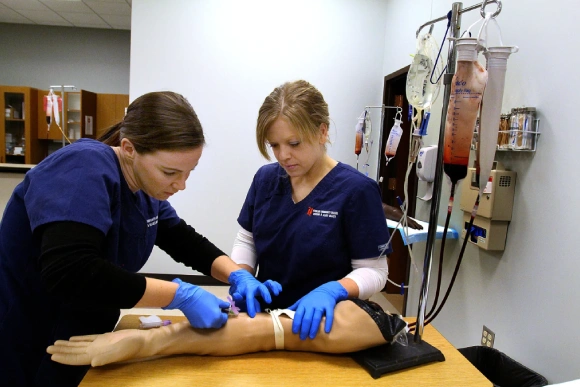
Accredited medical assistant programs build injection training around repetition, not a single demonstration. Expect to practice on training pads or mannequins first, then move to supervised practice with classmates or instructors before any patient contact happens.
NOTE: States like California require a minimum number of successfully performed injections of each type before a student is considered competent, and even where that number isn’t written into law, quality programs hold themselves to a similar standard.
How to Overcome Nervousness When It Comes to Administering Injections
It’s common to feel nervous the first time you’re handed a syringe, even in a controlled classroom setting. The only real answer is to practice, but how?
This is why it’s important to choose the right training program; structured, teacher-led instruction helps here, since an instructor correcting your angle or technique in real time builds muscle memory faster than watching a video alone. By the time students reach a clinical externship, most report that the repetition from earlier coursework is what carries them through their first real patient injection.
CCI Training Center’s Medical Assistant Program offers a practice kit, which students can use to learn the fundamentals of administering an injection before the real (local) clinicals. |
Final Words
Medical assistants can give injections in nearly every state, as long as a licensed provider delegates the task and the MA has completed the right training, with New York standing as the notable exception. For students, the bigger takeaway is that injection competency doesn’t happen by accident. It comes from a structured, accredited program that builds hands-on practice into the curriculum from day one.
Program Offered
- Pharmacy Technician Training
- Online Medical Assistant
- Medical Billing and Coding Specialist Program
- Cloud Computing Technician Training
- Computer Network Technician
- Business and Accounting
- Radiology Technician Training
- Medical Assistant Program
- Computer Support Technician
- Cybersecurity Program
- Virtual Assistant Training

This article is written by
Share this article
Program Offered
- Pharmacy Technician Training
- Online Medical Assistant
- Medical Billing and Coding Specialist Program
- Cloud Computing Technician Training
- Computer Network Technician
- Business and Accounting
- Radiology Technician Training
- Medical Assistant Program
- Computer Support Technician
- Cybersecurity Program
- Virtual Assistant Training
This article is written by
Share this article
Frequently Asked Questions
Do medical assistants need special certification to give injections?
Not always by law, but most employers require it in practice. States like New Jersey and Washington make certification a formal requirement, while others leave it to the supervising physician’s judgment and the individual clinic’s policy.
Can medical assistants give allergy shots or hormone injections?
Yes, in states that permit MAs to give subcutaneous and intramuscular injections, allergy shots and hormone injections typically fall within that scope once a provider has delegated the task and confirmed the MA’s training.
What happens if a medical assistant gives an injection outside their scope of practice?
Consequences can include job termination, loss of certification, and professional discipline for both the MA and the supervising provider who authorized the task. In states with strict rules, like New York, performing injections without authorization can also carry legal consequences.
Is New York's medical assistant injection law expected to change?
State lawmakers have introduced bills that would allow trained, certified medical assistants to administer vaccines under provider supervision, but as it stands, the restriction under Education Law Section 6530(11) remains in effect.
How much practice do medical assistant programs include for injections?
Expect repeated, supervised practice sessions before any patient contact. Some states set minimum injection counts for each route, and accredited programs generally build in more repetition than the legal minimum to ensure genuine competency.
Can medical assistants give injections during flu season surges?
Yes, seasonal flu vaccination is one of the most common injection duties for MAs in states that permit it, provided the same training and delegation rules apply as they would at any other time of year.
Related Articles
 Pamela Christianson
 Pamela Christianson
 Pamela Christianson
 Pamela Christianson
 Pamela Christianson

CCI Training Center Proudly Completes
41 Years in Career Training Services