








Generic selectors
Exact matches only
Search in title
Search in content
Post Type Selectors

Summary

Medical Administrative Assistants play a crucial role in healthcare offices, managing various tasks like patient coordination and administrative workflows. They need skills like organization,
ℹ️ This summary was generated by AI and may contain inaccuracies or omissions. Please refer to the full article for complete information.

LSRT Clinical Placement: How To Find, Pitch, And Secure Your Own Externship Site

Contact Us

    View full terms

    This enables CCI Training Center to contact you regarding our services via SMS message to the phone number you provided above. Message and data rates may apply. Text "HELP" for support and "STOP" to cancel.

    * By clicking the button below as my official signature, I consent to representatives of CCI Training Center contacting me about educational opportunities via phone, text message, and email. I understand that my consent is not a requirement
    for any purchase.

    For more information about our graduation rates, the median debt of students who completed the program, and other important information, please refer to the Gainful Employment Disclaimers.

    Key Takeaways
    • Countering Liability Concerns: When requesting a site, immediately address the manager’s fear of “risk” by presenting proof of your radiation safety training and insurance coverage.
    • Targeting the Right Ask: Focus your requests on High-Volume Urgent Cares and Orthopedic clinics, as their patient mix (Chest, Extremities) aligns best with LSRT requirements.
    • Timing Your Request: Never ask during rush hours. Visit in person during “lull” times (10:00 AM – 11:30 AM or 2:00 PM – 3:30 PM) to get the manager’s full attention.
    • The Mandatory Document: You cannot secure a “Yes” without a Certificate of Insurance (COI). If your school does not provide it, you must purchase an individual policy (e.g., HPSO) before you ask.
    • Planning the Legal Delay: Even after a manager says “Yes,” the Affiliation Agreement takes 2–8 weeks to process. Start your search early to account for this contract phase.

    For students in online Limited Scope Radiologic Technologist (LSRT) programs, the transition from coursework to clinicals is often the most significant hurdle. If your program requires you to secure your own externship site, you may have already experienced the frustration of unreturned emails and vague rejections.

    It is important to reframe this rejection. It is rarely a reflection of your academic potential. Instead, it is usually a disconnect between how a student asks for help and how a clinical manager views their operations.

    To secure a placement, you need to understand the logistical reality of a working clinic and approach it as a future colleague.

    Why Clinical Managers View Students As Operational Liabilities (And How To Fix It)

    In many industries, interns are viewed as “free labor” for simple tasks. In radiology, the dynamic is different due to the nature of the work.

    A clinical manager’s primary metric is patient throughput and safety. Introducing a student into a high-volume environment inherently slows down the workflow. If a technologist is teaching you positioning, they are spending less time processing patients.

    Additionally, because the work involves ionizing radiation, there are strict legal and safety implications that do not exist in other fields.

    Guaranteed Clinical Placement for CCI Students:

    We understand that overcoming this “liability” stigma is difficult for an individual student. This is why the CCI Radiology Technician Training Program includes guaranteed clinical placement. We negotiate these relationships for you, so you can focus on your coursework rather than cold-calling managers.

    When you approach a site, your goal is not to hide this reality, but to acknowledge it. You must demonstrate that you have minimized the logistical friction of hosting you and communicate that you are safety-conscious, insured, and ready to assist with foundational tasks so their team can focus on complex cases.

    The 3 Best Clinical Environments For Limited Scope Students

    Success often depends on targeting facilities that match your scope of practice. Broadcasting your resume to every medical facility in your area is inefficient. Instead, focus on sites where your limited scope license aligns with their daily patient volume.

    1. High-Volume Urgent Cares

    • The Context: These facilities prioritize efficiency. The caseload is often heavily weighted toward chest X-rays (respiratory) and extremities (injuries).
    • Why it works: This volume correlates well with the core competencies required for most LSRT programs.
    • Approach: Highlight your readiness to handle routine volume, allowing staff to manage triage and complex patient care.

    2. Orthopedic Clinics

    • The Context: These clinics specialize in skeletal anatomy. They generally do not require fluoroscopy or CT, making them a focused environment for X-ray.
    • Why it works: Orthopedic practices often view students as a pipeline for future hires.
    • Approach: Emphasize your knowledge of skeletal anatomy and your interest in specializing in orthopedics.

    3. Chiropractic & Podiatry Offices

    • The Context: These are often smaller, private offices.
    • Important Note: Review your program’s clinical requirements carefully before committing. Podiatry is limited to the foot/ankle, and Chiropractic focuses largely on the spine. If your program requires competencies in the Chest or Abdomen, you may not be able to complete them here.
    • Strategy: These sites are excellent for specific “extremity” hours or as supplementary sites, but ensure they meet your state’s licensure requirements for a primary site.

    How To Approach Clinics For An Externship

    Sending generic emails to general inboxes (e.g., info@clinic…) rarely yields results because these inboxes are often managed by administrative staff, not clinical directors. A professional, in-person introduction is standard industry practice, provided it is done respectfully.

    The Best Times Of Day To Visit Clinics To Avoid Rejection

    Respect the clinic’s workflow. Avoid “opening rush” (8:00 AM – 9:30 AM) and “closing rush” (4:30 PM – 6:00 PM). The optimal windows for a professional introduction are typically during lower-volume periods:

    • Morning Window: 10:00 AM – 11:30 AM
    • Afternoon Window: 2:00 PM – 3:30 PM

    Verifying Student Malpractice Insurance Before You Apply

    Before interacting with a site, you must verify your malpractice coverage. This is often the first question a manager will ask.

    • School-Provided: Confirm if your tuition covers a blanket liability policy.
    • Student-Purchased: If your school does not provide coverage, you must purchase an individual student policy (e.g., through HPSO). Being able to state, “I carry my own professional liability insurance,” removes the single biggest administrative barrier to your acceptance.

    The In-Person Introduction: What To Say 

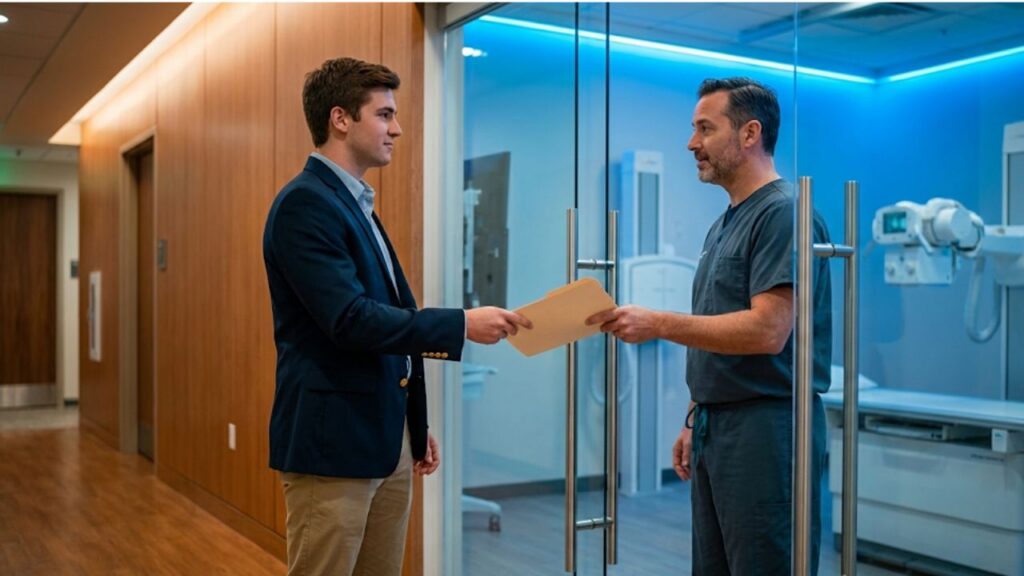
    When you arrive, dress in business casual or clean scrubs. Your goal is to be concise and professional. You do not need a script, but you should cover three key data points immediately to respect their time:

    1. Identity & Program: State your name and that you are an LSRT student.
    2. Logistics: Confirm you have liability insurance and your own dosimeter (radiation badge).
    3. Intent: Clarify that you are seeking unpaid clinical hours for competency, not immediate employment.

    Required Onboarding Documentation & Immunizations

    If a clinical manager agrees to host you, the onboarding process needs to be seamless. Delays in paperwork can cause an offer to be rescinded. Maintain a physical or digital portfolio containing:

    • Proof of Liability Insurance (COI).
    • Current Immunization Records (Hep B, MMR, Varicella, Tdap, and a TB test within the last 12 months).
    • Current BLS/CPR Certification (American Heart Association is the standard).
    • Background Check & Drug Screen results (if available/required).

    Understanding The Legal Affiliation Agreement Process

    Once a Lead Tech or Manager agrees to host you, there is one final administrative step: The Affiliation Agreement.

    This is a contract between your school and the clinical site. It acts as the legal framework for your externship.

    Note: This process can take anywhere from 2 weeks to 2 months to finalize, depending on the facility’s legal department.

    Recommendation: Do not wait until the week before classes start. Begin your search at least one semester in advance to account for this processing time.

    Summary: Success Requires Logistics, Not Just Grades

    Finding an externship is a professional exercise in logistics and networking. It requires you to be organized, resilient, and aware of the operational needs of the facilities you are approaching.

    By targeting the right facilities (Urgent Care/Ortho), preparing your insurance and documentation in advance, and respecting the clinic’s time, you present yourself not as a burden, but as a prepared future professional.

    To ensure you impress your clinical supervisor and turn those hours into a potential job offer, read our guide on How to Make the Most Out of Your Externship.

    FAQ’s

    I’ve emailed 20+ clinics and no one is replying. Am I blacklisted?

    No, you are likely just being filtered by the receptionist. General inboxes are often ignored. You must go in person during “lull hours” (10:00 AM – 11:30 AM) and ask to speak directly to the Lead Tech or Office Manager.

    Proceed with extreme caution. LSRT licenses are state-specific, not national. If you complete clinical hours in a state with “loose” laws (like Missouri), those hours may not count if you intend to work in a “strict” state (like California or Washington). Always verify with the health department of the state where you plan to work.

    Most schools do, but you need to prove it immediately. Download your Certificate of Insurance (COI) from your student portal and carry a physical copy. If your school does not provide coverage, you must purchase an individual student policy (e.g., through HPSO) before approaching any site.

    Only for part of your training. Chiropractors primarily image spines, but most LSRT programs require competencies in the chest and Extremities to graduate. You can use a chiropractor for spine hours, but you will likely need a second site (like an Urgent Care) to complete your full list of required exams.

    Related Articles

    CCI Training Center Proudly Completes

    41 Years in Career Training Services