










Summary


Key Takeaways:
|
Demand for certified medical coders in the U.S. continues to rise, reflecting the expanding medical coding market, which is projected to grow at a CAGR of 10% from 2025 to 2033. If you are one of the many aspiring professionals planning to take the CPC exam in 2026, you are making a smart and timely career move.
All you need is clear, up-to-date information about the CPC exam eligibility requirements. Knowing what to expect in advance allows you to prepare strategically and avoid unnecessary confusion. However, with so many guides available online, finding accurate and specific information about each aspect, including passing scores and exam fees, is a tougher task, as it often takes extra time to verify which sources are reliable.
To make things easier, we have created this comprehensive guide covering everything from the CPC exam cost breakdown to practical preparation tips.
What is the CPC Certification?
Offered by the AAPC, it is a nationally recognized medical coding credential. This certification validates a coder’s ability to accurately translate medical procedures, diagnoses, and services into standardized codes used for billing and insurance claims. The CPC exam tests proficiency in major coding systems, including:
- CPT® (Current Procedural Terminology)
- ICD-10-CM (International Classification of Diseases, 10th Revision, Clinical Modification)
- HCPCS Level II (Healthcare Common Procedure Coding System)
Earning the CPC credential demonstrates that you understand medical terminology, anatomy, coding guidelines, and healthcare compliance regulations. CPC certification is widely accepted by physician offices, hospitals, outpatient centers, and medical billing companies.
Even though of has industry recognition, many employers prefer or require CPC certification when hiring medical coders. This certification also ensures that you secure a job that offers a good salary. To learn in detail about the job outlook for medical billing and coding specialists, read this guide.
CPC Exam Eligibility Requirements
- A mandatory college degree is not required to take the CPC exam, but completing formal medical coding training is required.
- AAPC recommends two years of professional coding experience for full CPC certification.
- Candidates who pass the exam without meeting the experience requirement receive the CPC-A (Apprentice) designation instead of full CPC status.
- The “A” stands for Apprentice and can be removed after completing the required work experience or an approved education/practicum pathway.
You can remove the “A” (Apprentice) from your CPC-A credential in three ways.1. Completing 2 years of on-the-job coding experience 2. Competing one year of coding experience + Education (either AAPC’s Practicode program or an approved school. 3. Completing both AAPC’s Practicode program and an 80-hour medical coding course. Once you have met the removal requirement, submit proof of education or experience via the Apprentice Removal Application and get full CPC status. |
CPC Exam Format and Structure
The CPC certification exam consists of 100 multiple-choice questions (MCQs) to be completed in 4 hours. The exam format is designed to assess competency across 17 different knowledge areas, covering coding guidelines, compliance, and medical concepts.
Take a look below to know in-depth how the 100-question CPC exam is structured around the following core subject areas:
- Medical terminology (4 questions)
- Anatomy (4 questions)
- Compliance and regulatory (3 questions)
- Coding guidelines (7 questions)
- ICD-10-CM (5 questions)
- HCPCS Level II (3 questions)
- CPT®
- 10000 series codes (6 questions)
- 20000 series codes (6 questions)
- 30000 series codes (6 questions)
- 40000 series codes (6 questions)
- 50000 series codes (6 questions)
- 60000 series codes (6 questions)
- Radiology codes (6 questions)
- Pathology and laboratory codes (6 questions)
- Medicine (6 questions)
- E/M (6 questions)
- Anesthesia (4 questions)
- Cases (10 cases, 1 question each)
Quick Key Exam Details:
|
CPC Passing Score
To pass the CPC exam, you must answer at least 70 of the 100 questions correctly. If you do not pass, you will be notified of the subjects or areas of study with scores of 65% or less to assist you in preparing for retesting. If a first-time attempter, the CPC exam pass rate is 65-70% on average.
| NOTE: You can check your CPC exam results in your My AAPC account under My Exams. Results are usually posted within 7 to 10 business days. If you pass, your certificate will be mailed to you. You also need to maintain your AAPC annual membership and earn 36 CEUs every two years to maintain your CPC credential. |
CPC Exam Cost Breakdown
If you are ready to schedule your CPC exam, you have two options to choose from:
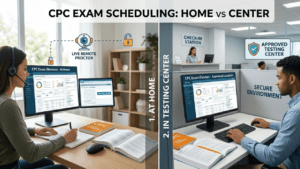
- Take the exam from home with a live remote proctor.
- Take the exam at an approved testing center.
To view available exam dates and time slots, you must first purchase an exam voucher. The cost of the CPC exam is $425 for one attempt or $499 for two attempts, giving you the option to retake the exam if needed.
| NOTE: An active membership with the American Academy of Professional Coders (AAPC) is mandatory to register for the exam and must be maintained after passing to keep the certification active. |
How to Prepare for the CPC Exam?
Now that you understand all the CPC exam requirements, the next step is preparing strategically so you can crack the exam with confidence. Here are key preparation tips explained clearly:
1. Invest Fixed Study Hours Daily
Set aside at least 2–3 dedicated hours every day for focused study. Consistency is more effective than long, irregular sessions. Create a weekly study schedule that systematically covers different subjects. Daily revision strengthens retention and prevents last-minute stress. Even on busy days, try to revise at least one topic to maintain momentum and discipline.
2. Master Your Coding Manuals
Because the CPC exam is open-book, knowing how to navigate your CPT®, ICD-10-CM, and HCPCS Level II manuals is essential. Practice locating codes quickly using the index and guidelines. Tab important sections and highlight key notes for faster reference. The goal is not memorization but efficiency, so that you should be able to find accurate codes confidently within minutes.
3. Give Regular Mock Tests
Taking full-length mock exams under timed conditions is critical for success. Practice answering 100 questions within four hours to simulate real exam pressure. Mock tests help identify weak areas, improve accuracy, and build stamina. Analyze your mistakes carefully after each test so you can avoid repeating them on the actual exam.
4. Focus on Weak Areas
After each practice test, review the questions you answered incorrectly. Identify patterns in your mistakes, whether related to modifiers, guidelines, or specific CPT sections. Spend extra time strengthening those topics. Improving weak areas can significantly boost your overall score and increase your confidence before exam day.
5. Practice Time Management
You will have about 2.4 minutes per question, so managing time effectively is crucial. Avoid spending too long on difficult questions. Consider marking them and returning later if needed. Maintain a steady pace when answering during practice sessions. Proper time management ensures you complete all questions without rushing at the end.
| If you are looking for a reliable institution to prepare for the CPC exam, consider the CCI Training Center Medical Billing and Coding Program. The course curriculum closely aligns with industry certification standards to help students build the knowledge needed for the CPC exam. Also, our program includes an externship component to ensure you gain hands-on coding skills and workplace exposure. |
Conclusion
The CPC exam is a valuable step toward building a successful medical coding career. By understanding the eligibility requirements, exam cost, format, and passing score, you can prepare with clarity and confidence. With consistent study, smart time management, and regular mock practice, passing the CPC exam on your first attempt is absolutely achievable. Stay focused, follow a structured plan, and take the next step toward earning your CPC credential.
 Pamela Christianson
 Pamela Christianson
 Pamela Christianson
 Pamela Christianson
 Pamela Christianson
 Pamela Christianson