













Quick Summary
|
Landing the perfect job in 2025 requires more than just qualifications on paper—it demands mastery of the art of the interview. With recruiters sifting through countless resumes, the interview becomes the deciding factor that sets one candidate apart from another.
According to the U.S. Bureau of Labor Statistics (BLS), the hiring process averages several weeks, but interviews often make or break the decision.
Whether you’re fresh out of college or a seasoned professional, acing your interview can unlock career opportunities you’ve worked hard to achieve. This guide equips you with practical tips, proven strategies, and insider advice to succeed.
Why Interview Skills Are More Important Than Ever
Today’s job market is fast-paced and competitive. Employers don’t just assess your technical abilities—they evaluate adaptability, communication, cultural fit, and professionalism. With remote work and AI-based screening tools becoming standard, interview performance is the ultimate differentiator.
According to BLS data, sectors such as IT, healthcare, and business management continue to grow steadily, yet the competition for each role remains intense. Candidates who prepare well and demonstrate confidence during interviews consistently outperform equally qualified peers.
Step 1: Research and Preparation
What to do before your interview:
- Research the company: Understand its values, services, and latest developments.
- Study the role: Match your skills and experiences to the job description.
- Practice behavioral questions: Use the STAR Method (Situation, Task, Action, Result).
Common Questions and Strong Approaches
| Common Interview Question | Weak Answer Example | Strong Answer Example (STAR) |
| Tell me about yourself. | “I’m hardworking and reliable.” | “In my previous role, I improved customer satisfaction scores by 20% by implementing a new feedback system.” |
| What’s your weakness? | “I work too hard.” | “I sometimes take on too many tasks, but I’ve learned to prioritize by using project management tools.” |
| Why should we hire you? | “I really need this job.” | “I bring 5 years of IT experience and have successfully led multiple projects that saved costs and improved efficiency.” |
See our guide on 18 Proven Interview Tips: Before, During, and After.
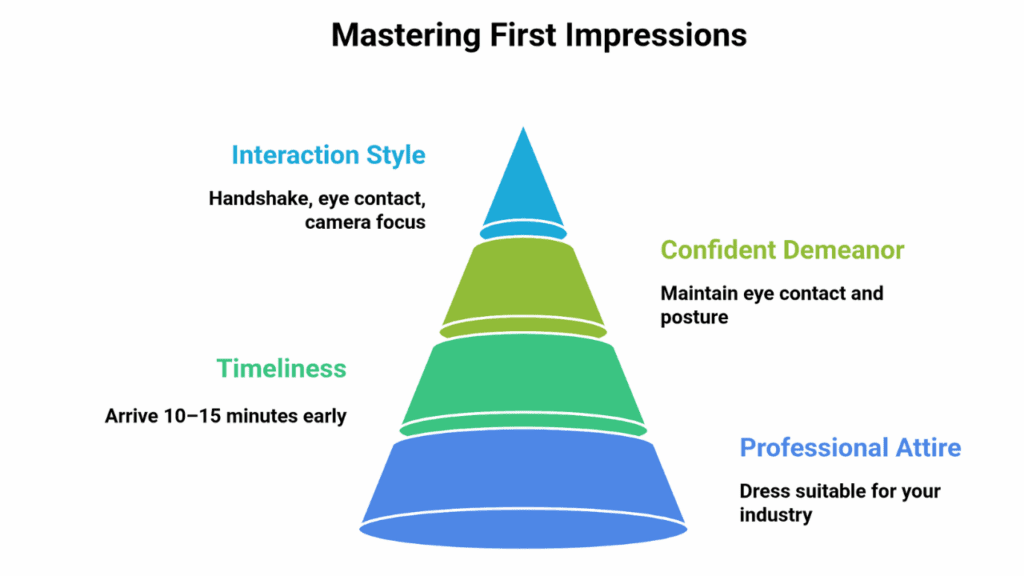
Step 2: Perfecting First Impressions

First impressions form within 7 seconds—and they’re often lasting.
Checklist:
- Dress professionally, suitable for your industry.
- Arrive 10–15 minutes early.
- Maintain eye contact, confident posture, and a welcoming demeanor.
In-Person vs. Video Interview Best Practices
| Aspect | In-Person Interview | Video Interview |
| Attire | Full professional attire | Professional attire, avoid busy patterns |
| Punctuality | Arrive early | Log in 10 minutes early |
| Environment | Company office | Quiet, well-lit room with neutral background |
| Interaction Style | Handshake, eye contact | Look into the camera, check audio clarity |
Step 3: Communication Skills that Win
Communication is more than just the words you speak—it’s about how you deliver them, the confidence you project, and the stories you tell. Strong communication can transform a simple answer into a memorable moment that resonates with interviewers.
Be Clear and Concise
Long, unfocused answers can lose an interviewer’s attention. Instead, keep your responses structured and direct. Aim for 1–2 minutes per question, long enough to demonstrate your skills but short enough to maintain interest. If a question has multiple parts, address each systematically.
Use Numbers, Facts, and Evidence
Whenever possible, quantify your achievements. Employers are far more impressed by measurable outcomes than vague statements. For example:
- Instead of saying: “I improved efficiency.”
- Say: “I increased efficiency by 30% by introducing a new reporting tool that reduced manual work.”
This approach not only shows that you’re results-driven but also helps the interviewer visualize the impact of your contributions.
Tell Stories That Stick
Facts and figures are powerful, but storytelling makes your answers memorable. Use the STAR method (Situation, Task, Action, Result) to frame your experiences. This ensures your response flows logically and ends with a clear accomplishment.
Ask Thoughtful Questions
An interview is a two-way conversation. By asking smart questions, you demonstrate genuine interest and help assess if the company is right for you. Prepare 2–3 thoughtful questions that go beyond salary or benefits.
Examples of questions to ask:
- “What does success look like in this role during the first 6 months?”
- “What are the biggest challenges the team is currently tackling?”
- “How does this position contribute to the company’s long-term goals?”
Pro Tip: Avoid asking questions you could easily find online. Instead, focus on queries that show you’ve done your homework and care about growth and collaboration.
Step 4: Highlighting Achievements with Impact
In today’s competitive job market, generic claims like “I’m hardworking” or “I’m a team player” simply don’t cut it. To stand out, you must back your statements with specific, measurable, and results-oriented examples.
Why Evidence Matters
Employers want to know not only what you did, but also how well you did it. Concrete examples prove your value and help the interviewer picture you making a similar impact in their organization.
Examples of Strong Statements
Here are a few powerful ways to transform vague claims into compelling results:
- Weak: “I helped improve processes.”
Strong: “I reduced processing time by 30% by automating workflows with new software.” - Weak: “I supported the team.”
Strong: “I trained 10 new employees, 4 of whom were promoted to leadership roles within 2 years.” - Weak: “I worked on marketing projects.”
Strong: “I spearheaded a marketing campaign that generated a 15% increase in revenue within one quarter.”
Use the Formula: Skill + Action + Result
A simple way to frame your accomplishments is:
- Skill: What strength or expertise did you use?
- Action: What did you do specifically?
- Result: What measurable impact did it create?
Example:
- Skill: Project Management
- Action: Coordinated a cross-functional team of 8 to deliver a new software launch.
- Result: Launched ahead of schedule and under budget, resulting in a 25% client satisfaction increase.
Go Beyond Job Duties
Many candidates fall into the trap of describing only their responsibilities. Instead, focus on achievements that highlight your value. Think of moments when you:
- Solved a problem no one else could.
- Took the initiative to improve a process.
- Exceeded expectations or targets.
- Helped your team achieve something measurable.
Pro Tip: Keep a personal log of accomplishments during your career. Reviewing this before an interview will give you a bank of impactful stories to draw from.
Step 5: Avoiding Common Mistakes
Many candidates lose opportunities due to small but costly errors.
Table: Common Mistakes vs. Best Practices
| Mistake | Why It Hurts | Best Practice |
| Arriving late | Shows a lack of responsibility | Plan commute, arrive 10–15 min early |
| Speaking negatively about past jobs | Signals poor professionalism | Focus on what you learned instead |
| Over-rehearsed answers | Sounds robotic, inauthentic | Practice, but keep it natural |
| Failing to ask questions | Appears disinterested | Prepare 2–3 thoughtful questions |
Learn more in Tips for Conquering the Phone Interview.
Step 6: Navigating Modern Interview Trends
The world of hiring has changed—remote interviews, AI screening, and hybrid processes are now standard.
Key Adjustments:
- For video interviews: Test technology, ensure lighting, and remove distractions.
- For AI assessments: Speak clearly and authentically, as software analyzes tone and keywords.
- For hybrid processes: Adapt seamlessly between online and in-person steps.
Mastering Behavioral and Situational Interview Questions
Often, employers assess your problem-solving and adaptability through behavioral questions.
Examples:
- “Tell me about a time you dealt with a difficult coworker.”
- “Describe meeting a tight deadline—what steps did you take?”
- “When did you take the initiative to improve a process?”
Answer Using STAR:
- Situation: Provide context briefly.
- Task: What did you aim to achieve?
- Action: How did you approach it?
- Result: What was the outcome? (Include measurable results if possible.)
Tips:
- Prepare 2–3 concise, versatile stories from actual experiences.
- Keep each example under 2 minutes.
- Highlight positive results and what you learned.
Step 7: Following Up the Right Way
A strong follow-up reinforces interest and professionalism. Send a thank-you email within 24 hours.

Template:
Subject: Thank You – [Your Name]
Dear [Interviewer’s Name],
Thank you for the opportunity to interview for [Position Title]. I enjoyed learning more about [Company Name] and your team’s goals. I’m enthusiastic about the chance to contribute my skills in [specific area discussed].
Best regards,
[Your Name]
Final Thoughts
Mastering interviews is about more than landing the job—it’s about building confidence and demonstrating your true value. By preparing well, showcasing results, avoiding mistakes, and following up thoughtfully, you set yourself apart from the competition.
Ready to accelerate your career?
- Explore Our Training Programs to upgrade your skills.
- Book a Free Consultation with a career advisor today.
Quick Summary
|
Why Interview Skills Are More Important Than Ever
Today’s job market is fast-paced and competitive. Employers don’t just assess your technical abilities—they evaluate adaptability, communication, cultural fit, and professionalism. With remote work and AI-based screening tools becoming standard, interview performance is the ultimate differentiator. According to BLS data, sectors such as IT, healthcare, and business management continue to grow steadily, yet the competition for each role remains intense. Candidates who prepare well and demonstrate confidence during interviews consistently outperform equally qualified peers.Step 1: Research and Preparation
What to do before your interview:- Research the company: Understand its values, services, and latest developments.
- Study the role: Match your skills and experiences to the job description.
- Practice behavioral questions: Use the STAR Method (Situation, Task, Action, Result).
Common Questions and Strong Approaches
| Common Interview Question | Weak Answer Example | Strong Answer Example (STAR) |
| Tell me about yourself. | “I’m hardworking and reliable.” | “In my previous role, I improved customer satisfaction scores by 20% by implementing a new feedback system.” |
| What’s your weakness? | “I work too hard.” | “I sometimes take on too many tasks, but I’ve learned to prioritize by using project management tools.” |
| Why should we hire you? | “I really need this job.” | “I bring 5 years of IT experience and have successfully led multiple projects that saved costs and improved efficiency.” |
Step 2: Perfecting First Impressions
First impressions form within 7 seconds—and they’re often lasting.
Checklist:
- Dress professionally, suitable for your industry.
- Arrive 10–15 minutes early.
- Maintain eye contact, confident posture, and a welcoming demeanor.
In-Person vs. Video Interview Best Practices
| Aspect | In-Person Interview | Video Interview |
| Attire | Full professional attire | Professional attire, avoid busy patterns |
| Punctuality | Arrive early | Log in 10 minutes early |
| Environment | Company office | Quiet, well-lit room with neutral background |
| Interaction Style | Handshake, eye contact | Look into the camera, check audio clarity |
Step 3: Communication Skills that Win
Communication is more than just the words you speak—it’s about how you deliver them, the confidence you project, and the stories you tell. Strong communication can transform a simple answer into a memorable moment that resonates with interviewers.Be Clear and Concise
Long, unfocused answers can lose an interviewer’s attention. Instead, keep your responses structured and direct. Aim for 1–2 minutes per question, long enough to demonstrate your skills but short enough to maintain interest. If a question has multiple parts, address each systematically.Use Numbers, Facts, and Evidence
Whenever possible, quantify your achievements. Employers are far more impressed by measurable outcomes than vague statements. For example:- Instead of saying: “I improved efficiency.”
- Say: “I increased efficiency by 30% by introducing a new reporting tool that reduced manual work.”
Tell Stories That Stick
Facts and figures are powerful, but storytelling makes your answers memorable. Use the STAR method (Situation, Task, Action, Result) to frame your experiences. This ensures your response flows logically and ends with a clear accomplishment.Ask Thoughtful Questions
An interview is a two-way conversation. By asking smart questions, you demonstrate genuine interest and help assess if the company is right for you. Prepare 2–3 thoughtful questions that go beyond salary or benefits. Examples of questions to ask:- “What does success look like in this role during the first 6 months?”
- “What are the biggest challenges the team is currently tackling?”
- “How does this position contribute to the company’s long-term goals?”
Step 4: Highlighting Achievements with Impact
In today’s competitive job market, generic claims like “I’m hardworking” or “I’m a team player” simply don’t cut it. To stand out, you must back your statements with specific, measurable, and results-oriented examples.Why Evidence Matters
Employers want to know not only what you did, but also how well you did it. Concrete examples prove your value and help the interviewer picture you making a similar impact in their organization.Examples of Strong Statements
Here are a few powerful ways to transform vague claims into compelling results:- Weak: “I helped improve processes.” Strong: “I reduced processing time by 30% by automating workflows with new software.”
- Weak: “I supported the team.” Strong: “I trained 10 new employees, 4 of whom were promoted to leadership roles within 2 years.”
- Weak: “I worked on marketing projects.” Strong: “I spearheaded a marketing campaign that generated a 15% increase in revenue within one quarter.”
Use the Formula: Skill + Action + Result
A simple way to frame your accomplishments is:- Skill: What strength or expertise did you use?
- Action: What did you do specifically?
- Result: What measurable impact did it create?
- Skill: Project Management
- Action: Coordinated a cross-functional team of 8 to deliver a new software launch.
- Result: Launched ahead of schedule and under budget, resulting in a 25% client satisfaction increase.
Go Beyond Job Duties
Many candidates fall into the trap of describing only their responsibilities. Instead, focus on achievements that highlight your value. Think of moments when you:- Solved a problem no one else could.
- Took the initiative to improve a process.
- Exceeded expectations or targets.
- Helped your team achieve something measurable.
Step 5: Avoiding Common Mistakes
Many candidates lose opportunities due to small but costly errors.Table: Common Mistakes vs. Best Practices
| Mistake | Why It Hurts | Best Practice |
| Arriving late | Shows a lack of responsibility | Plan commute, arrive 10–15 min early |
| Speaking negatively about past jobs | Signals poor professionalism | Focus on what you learned instead |
| Over-rehearsed answers | Sounds robotic, inauthentic | Practice, but keep it natural |
| Failing to ask questions | Appears disinterested | Prepare 2–3 thoughtful questions |
Step 6: Navigating Modern Interview Trends
The world of hiring has changed—remote interviews, AI screening, and hybrid processes are now standard.Key Adjustments:
- For video interviews: Test technology, ensure lighting, and remove distractions.
- For AI assessments: Speak clearly and authentically, as software analyzes tone and keywords.
- For hybrid processes: Adapt seamlessly between online and in-person steps.
Mastering Behavioral and Situational Interview Questions
Often, employers assess your problem-solving and adaptability through behavioral questions.Examples:
- “Tell me about a time you dealt with a difficult coworker.”
- “Describe meeting a tight deadline—what steps did you take?”
- “When did you take the initiative to improve a process?”
Answer Using STAR:
- Situation: Provide context briefly.
- Task: What did you aim to achieve?
- Action: How did you approach it?
- Result: What was the outcome? (Include measurable results if possible.)
Tips:
- Prepare 2–3 concise, versatile stories from actual experiences.
- Keep each example under 2 minutes.
- Highlight positive results and what you learned.
Step 7: Following Up the Right Way
A strong follow-up reinforces interest and professionalism. Send a thank-you email within 24 hours.
Template:
Subject: Thank You – [Your Name] Dear [Interviewer’s Name], Thank you for the opportunity to interview for [Position Title]. I enjoyed learning more about [Company Name] and your team’s goals. I’m enthusiastic about the chance to contribute my skills in [specific area discussed]. Best regards, [Your Name]Final Thoughts
Mastering interviews is about more than landing the job—it’s about building confidence and demonstrating your true value. By preparing well, showcasing results, avoiding mistakes, and following up thoughtfully, you set yourself apart from the competition. Ready to accelerate your career?- Explore Our Training Programs to upgrade your skills.
- Book a Free Consultation with a career advisor today.

 Pamela Christianson
 Pamela Christianson
 Pamela Christianson
 Pamela Christianson
 Pamela Christianson
 Pamela Christianson