










Key Takeaway
|
When patients evaluate their healthcare experience, they rarely judge the medical science. They judge the process.
They remember how long they waited, whether they felt heard, and if their billing was accurate. As a Medical Assistant (MA), you control that process.
The MA role is not just an entry-level clinical job. It is the operational foundation of modern healthcare facilities. Medical Assistants physically bridge the gap between administrative efficiency and clinical care.
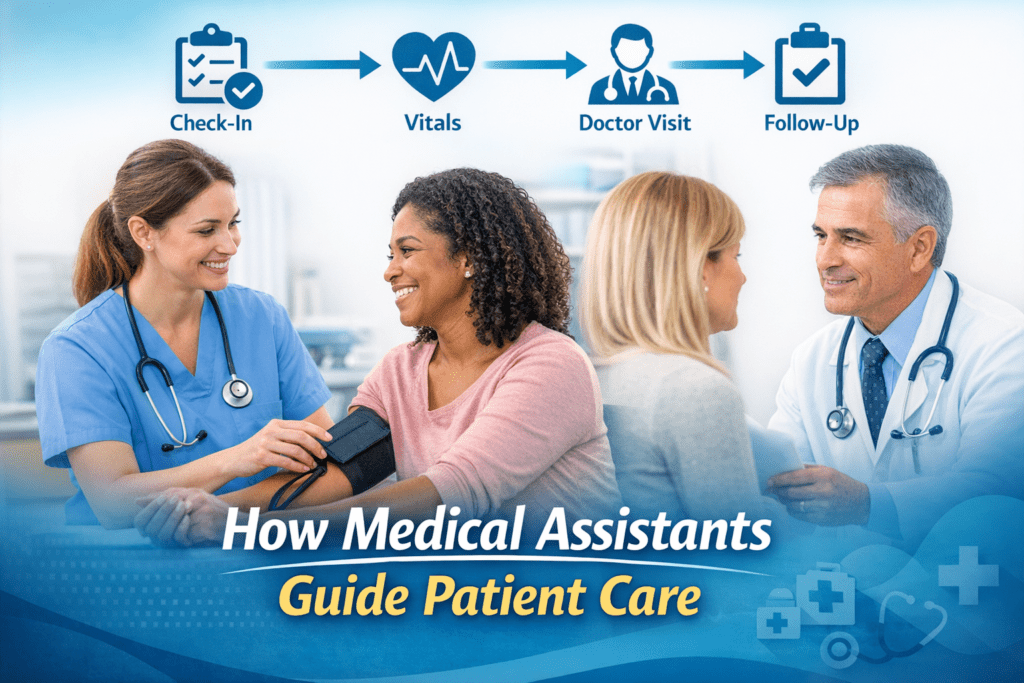
For anyone considering this career, your work dictates patient satisfaction, clinical safety, and the financial health of the practice. Here is exactly how Medical Assistants guide patients through a successful medical visit, from the front desk to the follow-up call.
A patient’s anxiety often peaks before they even see a physician. The first phase of the patient journey focuses on administrative efficiency and environmental control.
The primary goal is simple: remove friction.
Long wait times are the primary driver of patient frustration. Modern MAs utilize digital check-in tools and electronic eligibility verification to accelerate this process.
Research indicates that utilizing electronic systems for insurance and benefit verification saves approximately 12 minutes per transaction.
By managing this workflow, MAs actively pull patients out of waiting room chairs and move them smoothly into the exam room.
Administrative precision is a core function of the role. Nearly 25% of front-end claim rejections are caused by invalid or missing demographic data, and another 17% are linked to incorrect insurance verification.
MAs double-check this information during intake.
Fixing a simple typo on a screen today prevents claim denials and protects the patient from unexpected “billing shock” weeks after their visit.
MAs manage the physical office environment. Implementing neutral colors, natural light, and clear physical layouts is scientifically proven to lower patient frustration.
Furthermore, MAs ensure the space is accessible.
They actively clear pathways and position sturdy chairs so patients with mobility issues can navigate the clinic safely and without embarrassment.
Many modern practices employ Virtual MAs working across different time zones. These professionals handle phone lines, appointment scheduling, and basic billing inquiries remotely.
This hybrid structure allows the in-office MAs to focus entirely on the physical patient in front of them.
When the front desk is not constantly interrupted by ringing phones, the patient never feels ignored.
Once the patient leaves the waiting room, the MA is usually the first clinical point of physical contact.
This interaction sets the baseline for the entire medical exam. A patient who does not trust the MA is unlikely to trust the physician.
Empathy in healthcare is not just a personality trait. It is a tactical, measurable skill. Professional MA programs teach the specific mechanics of building trust quickly during the intake process.
MAs utilize positive body language—maintaining consistent eye contact, keeping arms uncrossed, and nodding while the patient speaks.
Patients consistently interpret these physical, non-verbal signs of focus as direct indicators of a facility’s overall clinical competence.
Disparities in healthcare experiences are well-documented. Research shows that patients with limited English proficiency frequently report lower satisfaction rates and higher anxiety, even when medical interpreters are utilized.
MAs act as the critical human bridge to ensure all patients receive respectful, culturally sensitive care.
An MA’s physical presence, patience, and clear communication level the power dynamics, ensuring diverse patient populations feel secure in the clinic.
Medical terminology alienates patients and creates barriers to care. MAs routinely act as translators, breaking down complex medical jargon into plain English before and after the physician speaks.
If a patient does not understand their diagnosis, the mechanics of their treatment plan, or how to take their medication, they will not adhere to it.
MAs take the time to verify the patient actually comprehends the information, closing the gap between medical science and daily life.
Accurate diagnoses depend entirely on accurate information. Patients who feel overwhelmed, rushed, or judged will often hide symptoms, minimize their pain, or lie about their lifestyle habits.
By creating a comfortable, safe environment through active listening and open-ended questions, MAs encourage patients to be totally honest.
This proactive approach directly improves the accuracy of the medical history handed to the physician, preventing misdiagnoses.
During the clinical phase of the journey, the MA transitions into a technical support role.
The operational logic is simple: when an MA operates efficiently, the physician can dedicate 100% of their mental energy to diagnosis and treatment.
MAs are trained to perform the essential “hard skills” required to keep a clinic running smoothly and to reduce physician burnout.
Depending on state regulations, MAs take vital signs, perform phlebotomy (drawing blood), administer immunizations, run basic in-house laboratory tests, and handle wound care.
By executing these clinical duties, MAs dramatically expand the patient capacity of the practice.
A disorganized exam room delays care, increases the risk of contamination, and makes the visit feel chaotic.
MAs prepare the exam rooms in advance, lay out the necessary equipment for specific procedures, and establish a sterile environment before the doctor ever enters.
This preparation ensures the physician does not waste valuable appointment time hunting for supplies.
MAs act as a primary informational filter for the medical team.
By taking a thorough initial history and isolating the patient’s primary complaints, the MA relays accurate, structured data to the physician before they walk into the room.
This standardized process ensures that minor details, secondary symptoms, or hidden concerns are not overlooked.
For minor surgeries, biopsies, or uncomfortable physical exams, MAs remain in the room. They serve a crucial dual purpose in these moments.
Technically, they assist the physician and maintain the sterile field.
Emotionally, they stand by the patient to provide verbal reassurance, physical comfort, and distraction, actively reducing the patient’s procedural anxiety.
The patient journey does not end when the patient walks out the clinic doors.
Continuity of care is essential for achieving positive health outcomes, and MAs are typically responsible for managing this critical transition phase.
Post-discharge communication is a major metric for clinical success. Research shows that patients who receive a follow-up call are over six times more likely to give a top rating for recommending the facility, regardless of how long they waited during their actual visit.
MAs conduct these outbound calls to check on the patient’s recovery progress, confirm they filled new prescriptions, and answer lingering questions.
By consistently monitoring a patient’s progress through these follow-ups, MAs can identify medical complications before they escalate.
If a patient reports that a new medication is causing severe side effects, or that a post-surgical wound is showing signs of infection, the MA immediately escalates the issue to the physician.
This proactive intervention frequently prevents manageable issues from turning into costly Emergency Room visits.
Ultimately, MAs empower patients to take control of their own healthcare. They provide targeted educational brochures, explain preventive care strategies, and train patients on how to navigate the clinic’s digital platforms.
By teaching a patient how to use the Patient Portal, the MA gives them 24/7 access to their lab results, upcoming appointment schedules, and secure direct messaging with the clinical team.
The daily tasks of a Medical Assistant directly alter patient outcomes. Here is a clear breakdown of how specific MA actions solve common patient problems:
| If a Patient feels… | The Medical Assistant… | The Result |
| Nervous or Scared | Uses empathy, positive body language, and active listening. | The patient relaxes, builds trust, and shares accurate medical information. |
| In a Rush | Utilizes digital check-in tools and manages clinic workflow. | The patient waits less, reducing frustration and keeping the clinic on schedule. |
| Confused by Bills | Explains insurance coverage, co-pays, and deductibles upfront. | Eliminates “billing shock,” reducing stress and unpaid clinic invoices. |
| Ignored or Different | Provides culturally sensitive care and plain-language explanations. | The patient feels respected, understood, and confident in their care plan. |
| Worried at Home | Makes a proactive follow-up call to monitor recovery. | 2x higher patient satisfaction and a safer, closely monitored recovery process. |
A career as a Medical Assistant is a career in operational problem-solving and human connection. An MA’s daily work directly affects a clinic’s official patient satisfaction surveys, commonly known as HCAHPS scores.
In the modern healthcare system, high HCAHPS scores dictate how much insurance companies reimburse the facility.
When MAs excel at their jobs—reducing errors, managing workflows, and communicating clearly—the clinic becomes more successful, and patients receive demonstrably safer care.
This article is written by
Share this article
This article is written by
Share this article
Use “Adaptive Communication” to match the patient’s immediate state. Use calm small talk for anxious patients, and switch to short, direct answers for patients in a rush. Ask open-ended questions and stop reading robotic courtesy scripts.
Focus on cultural competency and data precision. Practice Shared Decision-Making (SDM) to overcome language barriers. Operationally, double-check all demographic data during intake—simple typos cause 25% of front-end claim rejections.
Quality improvement means upgrading systems to remove friction. Examples include:

Providing accredited career training for decades, CCI Training Center is a name that is well recognized and trusted among employers in the fields of Information Technology, Medical / Healthcare, and Business & Accounting. At CCI Training Center, we’re proud of the tradition of excellence we established with the first class of professional career training graduates in 1984.

The experts at CCI career training center have been preparing thousands of adults for new careers or assisting them in enhancing their current careers through our fast-track online career training program.

Providing accredited career training for decades, CCI Training Center is a name that is well recognized and trusted among employers in the fields of Information Technology, Medical / Healthcare, and Business & Accounting. At CCI Training Center, we’re proud of the tradition of excellence we established with the first class of professional career training graduates in 1984.
The experts at CCI career training center have been preparing thousands of adults for new careers or assisting them in enhancing their current careers through our fast-track online career training program.
CCI Training Center Proudly Completes
41 Years in Career Training Services